


“Eindhoven Dakar art and design rally”
All three of my daughters, as a reward for something they achieved in their lives and did their best (it shouldn’t be too easy), got to choose a trip with me. Dear and Rose decided to go to Japan after passing their exams. Pretty smart, since they know that’s my favorite destination. Just like with choosing a story in the past, when they also quickly realized that they would be read to much longer if I liked it too, they now knew that they got more “value for money” if they went to Japan. It’s been years, but they were very special trips that I can still remember all sorts of things about. But Geertje thought, when she finished her studies, I want something very special and different. A few years ago we thought of going to the art biennial in Dakar. The city of the Baobabs where Orchestra Baobab played as the house band in the club of the same name more than 50 years ago and caused a furor there.
Africa fascinates me immensely and art is like a mirror for society, it is like a thermometer in society. Because this is an adventure, we booked tickets on time. A month ago, it was suddenly announced that the biennial has been moved up a few months. We were in doubt whether to go. No festival then, and I’m sure there will be plenty of art to see and we’ll just experience the city as it is. Geertje thinks she will also be much too busy in November, so we will go on the planned date. I have booked hotel Lagon 2, a 1970s hotel built on the coast half in the sea. The restaurant of the same name (Lagon 1) is built a few hundred meters away on a pier.
We drive to Brussels very early in the morning, because there are direct and affordable flights from there. Makes sense, since Belgium has a much more recent vibrant history with Africa. But whether that is so positive, one might wonder. We haven’t yet figured out how to get from the airport to the hotel. The brand-new airport, built by the Chinese, is outside the city, and the track serving the train link, partly built by the French but now being finished by the Chinese, has not yet arrived. So we have to take a cab. As soon as we walk toward the exit, we are accosted by a large number of drivers.

We do not know then that we must learn very quickly to shake off people who want something (money) from us in a friendly way. Now the first driver is successful right away, we walk with him and get in. It is our first cab. An old thing, worn-out upholstery, everything doesn’t work, but the air conditioning does, we don’t know then how special that is. I think people who do have it together know how to get a decent cab, but later come to the conclusion that they probably have their own transportation with drivers. The only recognizable cabs there are and driving around everywhere are yellow-black and on average almost all of them are in deplorable condition! We drive for more than an hour first through an arid landscape, but soon the suburbs begin. It is an endless road through an urban wasteland of unfinished buildings made of gray concrete bricks. Here and there laundry hangs outside, sometimes a house is plastered, the mosques are finished though, or under construction.
The road is incredibly crowded and dusty; the vast majority of cars would not pass inspection with us. In long random lines we drive to the center. If four cars can fit next to each other, four of us drive side by side, and if it gets narrower or a car is parked or there is just an object in the road, (seemingly for no reason) the driver merges boldly and routinely. So the number of lanes seems to be determined by how many cars fit side by side according to the road user, if it is slow, more will fit! Geertje finds it exciting, I thoroughly enjoy the anarchy and chaos.

Many of the vehicles are ancient Mercedes buses converted for passenger transport. The buses are all dented all around, provisionally dented out and beautifully painted. They are overcrowded, at the back of the running board are the luggers hanging from the steps with which they can raise the roof rack with huge mountains of luggage. We see cars with a few goats on the roof. We do not know then that next week, just after we will leave, there will be a festival where just about everyone eats goat. The city is teeming with goats. When we arrive at the hotel, it appears to be in a dilapidated state. Really something for me, but Geertje has counted on a luxury hotel and is somewhat disappointed. Months ago, when making the reservation, I asked for two separate beds. When I ask about it, the lady behind the front desk reads that that is indeed the case. There is some communication, a mattress is conjured up, and the doorman and a hotel employee walk with the mattress under their arm with us.
When we enter the room, they shoot in, pull open the sofa bed, throw the mattress on it and make the bed. Now we have the two twin beds we asked for. I was pretty sure the hotel would be good, because very good friends of ours who are quite fond of luxury recommended it, but am now doubting it a bit. Later I consider that they probably slept in one of the upstairs suites. I actually love it, the hotel is old and worn, built long ago with a lot of feeling and attention, then not refurbished and so ruined, so it is still an experience. It is built half in the sea.
We walk to the rooms with on our right against the old coastal rocks a kind of jungle and on the left the building with doors to the rooms. Rather large areas with black lacquered shutters and panels with a window between them and the entrance to the rooms. They are round windows and doors. The railing to the jungle slants away, it’s like walking to your cabin on the deck of a ship. Later I see that the corridor below us and actually the whole first floor is not maintained at all, I think some of the staff sleep there.

The same evening we dine at the restaurant on the pier. It is beautifully maintained, again with a maritime theme, but instead of modern architecture it is much more classically built of ship parts; varnished wood, brass and copper windows, fish on the ceiling and pictures of watermen from days gone by on the walls. Later we learn they are more than 50-year-old photos of the restaurant’s owners and their guests and friends. Now the little boy in the pictures, the son and now a husband, runs the business. We have a wonderful time and eat reasonably and drink our first bottle of rosé. In Dakar there is a choice of three types of rosé. During the rest of our stay, it appears that all restaurants have the same offerings. If you go for expensive food, the same bottle is just a little more expensive.
Actually it happens the same way in the Netherlands, but with us it is less noticeable because of the wide choice. In Senegal, despite great mineral and fossil wealth and also ample opportunities, almost everything is imported. Concrete they do make themselves and that can be seen everywhere! We go to bed tired but satisfied after our first day. The next day we will figure out what to do. In any case, lots of art looking and trying to find music and walking around town!

Dakar
There is only a two-hour time difference, so getting up is almost effortless. Geertje is awake earlier than I am and is already busy working on her laptop. She spends the rest of the trip working in the morning and further whenever there is a moment. She is as driven as I used to be. I am more sluggishly processing the experiences and thinking about what we can do. I look up the first galleries we will visit and think we can walk the first part. Geertje is a little reluctant to walk because it is hot and it seems far. Of course we are going to walk anyway because that is the best way to explore a city.
We walk along the coastal road La Corniche first past the restaurant Lagon 1 (the hotel is Lagon 2) with its private beach. They have made a kind of pier to separate the paying guests from the locals. The “free beach” is a soccer beach with an incredible amount of trash against the slope and at the end of the beach a shantytown with some huts made of leftover material. The goals are made of two tires half-buried.
A little further on the other side of the road is the Pullman hotel, a dull large reddish-brown building atop the hillside with walls and buildings up to the road and its own swimming pool on the other side by the water. To the right along the high walls an old poorly maintained stone colorfully decorated staircase goes up.

At the service entrance and exit of the Pullman is the only ragged clochard we will see for the next few weeks. 93% of the population is Muslim, I understood divided into 3 movements and very tolerant towards each other and others. So there is virtually no drinking and so you also have less trouble with vagrants who keep themselves under cover all day and keep slipping away. At the service entrance of the Pullman it stinks because of that one clochard as it stinks in so many places in Paris.
On the other side of the stairs, lush vegetation can be seen above and behind a tight wall with a wooden door. The wooden door is the entrance to one of the few restored old colonial buildings that houses a small hotel-restaurant It turns out to be the place that was recommended to me after I had already booked Le Lagon. It is a lovely place, the cuisine is Italian and the people who work there, like almost everywhere else, are very nice and knowledgeable.
On the stairs we meet a young Frenchman. Senegal is a former French colony, so there are still a lot of French people there. He is a super nice man. He is in Dakar for a few weeks for the IMF (International Monetary Fund). Previously, he lived here for years. We exchange what is fun to do, or rather, we say what we are planning and he gives some tips. We talk a little more about politics and the just-elected prime minister that almost everyone I’ve talked to about it so far is very positive about. It’s quite a complicated story because the president has actually been advanced by a very well-liked politician who has been impeached and condemned for improper behavior toward his secretary.
No one really knows whether it is true or not, but he cannot therefore become president. The man he put forward is of impeccable conduct and, after taking office, announced that he was going to break open contracts with multi-nationals and countries to renegotiate agreements that would benefit the country. After quite an uproar broke out, he added that he will do so with respect for all concerned.
The young French banker says he is very curious to see how things will go with the new president. He calls him a racist. I ask what he means and he explains that he wants the whites (French) out of the country. I am amused though and tell him that so he is anti-colonialist and just wants to be independent? And that if he really does what he says, which is to ensure that the people are better off, that is the best thing that could happen to the country and, in fact, to everyone involved. I believe he agrees with me. So it is exciting whether the president is going to do what he promises, which would be quite extraordinary in Africa. The most appealing story that I keep hearing back is that when the president was elected, one of the first acts was to determine that because the country is a mess, it needs to be cleaned up.
Two Sundays a month everyone has to clean up. I ask how that is then paid for and received the answer that people respect the elderly (people in power) and that if something is asked, you do it. Moreover, everyone seems enthusiastic about the measure. They tell me that in two months the city is already a lot tidier.
Later I learn that in the time of the French, Dakar was a very green city. Now it is a kind of sand and stone city with a huge amount of poorly or unmaintained buildings from the colonial era, unpaved roads or roads where the pavement seems to have disappeared, many unfinished modern buildings and what has been completed is just plain ugly. Perhaps the most beautiful buildings are still the huge residential blocks built by the French along the central square (Place de l’Independance). You can see that opulent and luxurious apartments once sat there and that it really was an upscale center of the city.
We walk on and after the Pullman there are some modern and therefore ugly flats on the right. Shortly thereafter we pass between the road and the sea built a pretty crazy old villa that apparently last served as a beach club, but is now closed for demolition. The building is painted black and white and in a sort of alcove there is a half-sagged sign that reads “chantier interdit au public” (forbidden to sing in public). Because of my anything but perfect French, I read “chanter interdit au public,” which means “forbidden to sing in public.” However, it says “chantier” which means construction site! So it says “construction site forbidden to the public.” So maybe I misunderstood more! I think it is being demolished because it is presumably too close to the presidential palace. Almost immediately after the black and white villa, there is a long concrete wall built around the presidential gardens on the right side of the road.

Between the sea and the palace garden runs La Corniche, the long city coast road. So the president cannot walk from his garden to the sea. Indeed, there is a high concrete wall to protect him. After the palace, the road continues along the jagged coast. Down by the water are beautiful old buildings. They are empty or have been put to use by locals. An old hotel with outbuildings is now a place for fishermen. At this point the coast no longer belongs to the rich? They live in the large protective apartment buildings overlooking the sea. And have their own private beaches.
We pass a kind of park between the road and the sea. The steps and paths down are made of rubber tires filled with concrete. It is beautiful and effective. Geertje is on the road at the top of the path busy making phone calls to solve some production problems at home while I explore the rubber tire park. Geertje would like to stop by a pharmacy because we lost one prescription in the Netherlands so we only have half the malaria pills. I’m actually fine with it, but Geertje doesn’t want to take any risks. When we see a pharmacy, we go inside. It is quite a modern and well-kept store. We ask for the pills and it turns out they have exactly the same ones. We also want something like sunscreen and soon we are offered all kinds of other products. Geertje has only a very white and fragile skin, they think, and all sorts of things need to be put on it.
In the end I think it is indeed a good idea to buy something for after the sun for Geertje as well. We go to the cash register where the pin doesn’t seem to work, so we pay cash. One euro is about 650 Senegalese francs, we still have to get used to the exchange rate. When we are outside, it turns out that we have spent quite a lot. The malaria cure is not too bad, (as expensive as in the Netherlands) but the rest is not and the tube with aftersun is not in the bag at all. I think, if they have to pay all the people working in the store who otherwise probably don’t earn anything, it’s fine to overpay.
We walk on, there is plenty to see and I am not so concerned with the road. After a while I find it’s taking a long time anyway because we should be in the area with the galleries by now. I look at my phone and see that we missed the exit almost at the beginning. The route planner on my phone reports that the route is not known. The map with my position is there, so I just have to see where I am and know where the destination is, after that it gets better. So now we have to walk a long way and instead of going back over La Corniche, we go straight up towards our goal. Actually, I don’t really know where we want to go yet, because I haven’t been able to find it clearly, let alone put it on the map. As far as I know, it’s an urban district. When we have already walked a bit in what I think is the right direction, we get tired of it. We pass the bus station with the depot behind it; it is a sandy plain on a slope. At the top of the slope is a sort of cab stand. There are dozens of yellow-and-black cabs of which there are so many in the city. It is a motley collection of vehicles, not one of which is without a dent and almost all of which fit the description wreck. So far we haven’t seen a normal cab driving around, so we’ve come to the conclusion that there aren’t any. The cab men drive everyone around and provide the same service for tourists with a different price. Presumably they have no idea at all that the vehicle they drive is not even allowed on the road in the West and that their passengers are somewhat uncomfortable. By the way, it is quite possible to negotiate the price, but then you have to be better at it than they are, and for them it is their income, so I lose the negotiation game structurally, without really mind.
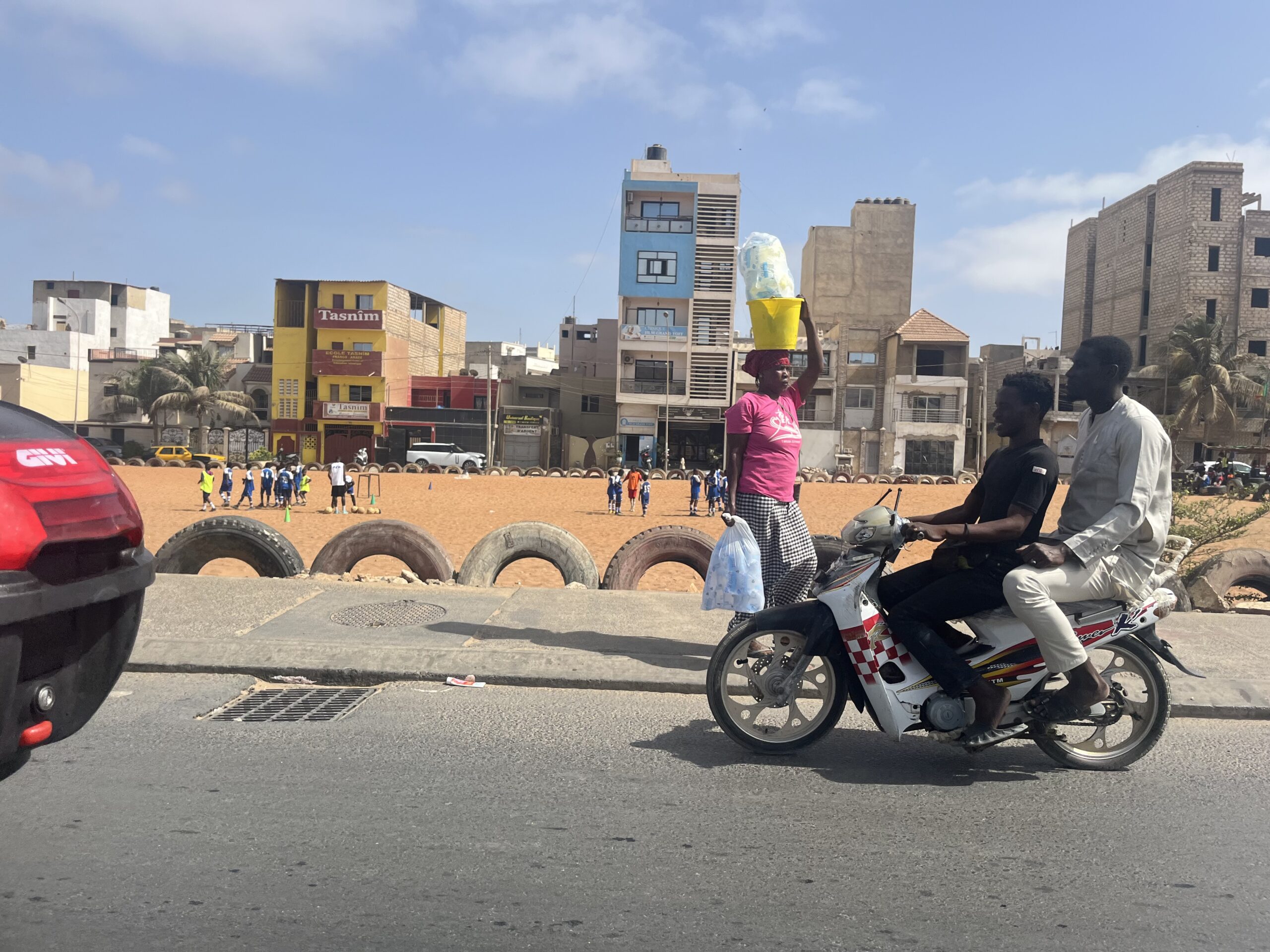
The cab men notice that we want a cab and try to offer us all a ride. We walk with the most hawkish one and discover that he is the proud owner of the biggest wreck of all.
We get in, me in the back right, and in the outside mirror, which is taped to the door at half past ten without the driver being able to see it, I see the cab number painted on the door. I love it and actually want to take pictures, but don’t dare because I think he won’t like it if I take pictures because it is broken while it is valuable to him. It is a miracle that the car drives. There are no buttons, radio, ashtray or sliders in the dashboard, it is a dusty gray-black cheese of holes with the guts of the car behind it. The headliner hangs at least 5 inches loose from the roof and the original brown soundproofing padding is visible on the sides. I wonder how the headliner stays put.
Photos would have been helpful to give a full description now. The driver puts down the handbrake and the car begins to roll off the ramp. He lets out the clutch, the car does not start at once, the second time it succeeds. Since he does not have a starter motor in addition to almost all the buttons, he always has to park on a mountain with free passage. We drive to an art gallery they all think I want to go to. It is in the direction of where I roughly thought we should be. The driver only charges 2000 francs, which is something like 3 euros, so the price is fine!
When we arrive, it turns out to be one of the busiest places in Dakar, and the gallery is not a gallery, but a gallery with lots of little stores. More like a bazaar, but with a lot of local art, or rather, tourist junk. We have not yet left the car, when a very nice man takes care of us. He speaks French and English. His French is “regular” French, rather than Senegalese French, so I can understand it well. Geertje does not speak French anyway, so it is nice that we can speak English. He takes us along all kinds of stores and friends, he seems to know everyone and instead of the stallholders offering us something he does, we are his customer. There seems to be an unwritten rule that if a handy trader hooks a tourist and manages to get high prices because he can talk well, you can just sell the stuff in someone else’s store. I assume they then go back later to renegotiate together who gets what.
I end up buying a soccer jersey of Senegal’s national soccer team which I think is quite appropriate, because there is soccer being played everywhere as it used to be with us. They are big athletic and ballsy guys who, instead of sitting behind the television or laptop, which they probably don’t even have, do nothing but play soccer. Senegal is bound to become world champions one day and I already have a shirt! Our self-imposed guide takes us to a road that I really want to enter, because behind a large gate I see an area with an enormous amount of old trucks and buses. Geertje has had enough, she feels embarrassed and wants to go back to the hotel to get out of the hustle and bustle. I brush the man off and we go in search of a cab, which we have fairly quickly. At the hotel we talk to the guard (there are guards everywhere) about our intention to go into town tomorrow to all sorts of galleries and he indicates that we can then take the driver that belongs to the hotel. For a program like the one we have in mind, that will cost about 20,000 francs, which is 30 euros, so quite doable. Geertje thinks it’s quite a lot, because she looked up that the minimum monthly wage in Senegal is 95 euros. We agree to go out with the driver at eleven the next morning.
We decide to do some more shopping. We walk down the road past the hotel to the colorful staircase up into town. In front of the hotel it is crowded with wheelchair beggars. I wonder why they are all begging in the same place. More spread out or not at the same time would be much more efficient. Maybe they also just like being together. The restaurant attracts rich people and apparently it is worth waiting there day in and day out. We walk past it, a very nice man starts walking up with us and makes contact at lightning speed.
Ha Dutch! He has lived in Rotterdam and speaks a few words of Dutch. Before we know it, he has given a present to Geertje that he really wants to give because he likes us so much. He soon knows we are looking for a supermarket and offers to take us. He has nothing to do anyway and has to go in that direction. When we arrive, I make another feeble attempt to indicate that we are quite capable of doing the shopping ourselves, but he is eager to come along. When I make it clear to him that we really don’t need him, he says that he doesn’t have to have anything, but he does have to take care of his wife and children and that of course he can’t do that without money. He will not leave before I give him something and if I want to give him a few thousand francs, (a few euros) it is far too little, because surely his wife and children need to eat more than just rice. To get rid of him, I end up giving 10,000 francs.
We come to the conclusion that I need to get a whole lot better at fobbing people off so I don’t feel like I’m being conned all the time.On the other hand; the man won’t be so shrewd if he had enough. A few days later we are walking through town. He recognizes us from afar and promptly walks up to us and shouts “my friends from Holland!” we make our way-get out. He has no idea that we feel he has tricked us!
When we get back to the hotel we decide to have dinner again in the evening at Lagon 1, the restaurant on the pier next to the hotel. We have a wonderful evening, the atmosphere and service are great, but the food is nothing to write home about. Almost all the other Europeans we talk to find the food there very good, so maybe it’s because of the choices we make. The people are very friendly. Geertje promptly makes contact with the owners and staff, so we have a very nice and pleasant time the following days. When we get home in the evening, I search the Internet so that I am well prepared for the next day. I want to direct the cab driver in the right direction and visit quite a few galleries.

Taximan
The taximan’s name is Bassirou, to friends it is Bas I hear later. He is young and strong and speaks Senegalese French, so I have to pull out all the stops. He has bad teeth and apparently never goes to the dentist. I have seen quite a few clinics, but considering the dentures, apparently it is not for everyone. It’s a shame, because he’s a nice guy. Today we have a regular driver who just waits for us when we go in somewhere. Sometimes he walks with us, which is quite convenient, because it means we get a lot less people coming at us wanting something. I ask him about everything I see and wonder about. He tells about the goats, that it will soon be a holiday and that everyone will be eating goat then, so the animals will soon be slaughtered.
The unfinished buildings are the result of legislation and crisis. They do not need to be finished and people build on when they have money again. During the corona crisis, many builders got into trouble, so there are more unfinished buildings than ever. He talks about how the president was elected and that he is doing so well. That he has yet to arrange a goat for his family and that it is expensive, but also that he and his father have two goats to sell (so I guess I don’t quite understand him). The city is actually quite safe as long as it is crowded, the quiet places are much more dangerous. We had just the opposite feeling. Bas explains that with La Corniche, the long coastal road, is very dangerous in the quiet places. Scooters drive right past you, grabbing everything loose and stuck. The cab is not his, but he would like to have his own. He is saving up for that, but it is not easy because he has to earn a living for his wife and children and parents. Talking and driving from one gallery to another, we get to know each other. I tried to plan the route cleverly, but sometimes we drive long stretches. That turns out to be quite an effective way to experience the city. It is a kind of panorama that passes by us. Dakar is lively. Everything and everyone lives, works and trades on the streets. A garage company simply repairs cars on the sidewalk. A jack underneath, the engine block out and you’re done. One of the main goals at the end of the day is Villages Des Arts, a village where artists live and work or display their work. They are old barracks made available to artists. Dakar has long had an art school and art seems to be rooted in the city. This is probably why the African Art Biennial is in Dakar. It’s a big site with many artists who are far from all there, but for the most part the studios are just open and there is a lot outside, so there is a lot to see and experience. There is also an exhibition area where an extremely unfriendly woman walks around. Later we understand from Bassirou that she had to pray (she did).
We didn’t exactly come at the very best time! It is a nice exhibition with a well-crafted catalog, but walking around outside and talking to the artists and seeing their work in the place where it is made is still much more interesting and penetrating. When I ask Bas if he doesn’t have to pray then, he says he does when he can, they are not that harsh in their teaching! We see beautiful work by various artists, but it is too much to see all at once, so we decide to go and come back later. We still have almost a week, after all.

In between business, I figure out where there are galleries and slowly but surely I’m starting to get a little more handy and understand the city better. We are actually right up against the old center where everything is quite walkable, so we go for a walk the following day. We see wonderful art in all kinds of areas. Some large galleries have very surprisingly beautiful museum installations. Dakar really is an art city. In the afternoon we meet with Bibi Seck, a designer with Senegalese roots. We got his name from Anaïs, a relation with whom we have very nice contact. She has a vacation home near Dakar where we are going in a few days and she is there regularly. She has given many tips and one of them is that we should meet. First we are at Selebe Yoon, a beautiful gallery on the top floor of what was once a French luxury department store.
We take a long look around and I marvel at the quality of the work and presentations, as well as the reception. At first I actually thought it was Bibi’s gallery, but after some careful fishing I discover that is not correct. It’s on the same street on the right further down on the opposite side of Place de l’Independance. Despite the fairly clear description, it is hard to find and the messages I send to Bibi apparently do not arrive. Eventually it turns out that the gallery design studio is on the upper floors and can be reached through a side entrance. We are a bit uncomfortable, in fact I have only briefly looked and seen that Bibi has a gallery, (which is also what Anaïs told me) but I do not know that he is a well-known designer. When we get upstairs, he is in conversation with a nice Frenchman. We exchange thoughts and slowly but surely things get a little more relaxed.
Geertje later says that is mostly to Bibi’s credit, because he is the one who keeps the conversation going. Bibi works with his wife; she is also a designer and is at work. It doesn’t make a splash, but it’s fun. We want to meet up for something to eat or drink together but it doesn’t seem to work out. We go to Anaïs’ vacation home in Saly and they leave Dakar when we return. We try to get together the same evening, but it doesn’t work out. I have a lovely dinner with Geertje at Seku Bi, the hotel restaurant along the colored staircase with the clochard that Anaïs actually advised us to stay at. Instead of past glory as in many places, it is restored romantic colonial glory here.
Orchestra Baobab
So I really wanted to go to Dakar because it is the city where Orchestra Baobab once played as a house band in the club of the same name. More than fifty years after the orchestra was founded, I went to a live concert with Steef just before we left for Dakar in Haarlem. Steef made contact and we found out that they are performing today on the beach at the club La Mer a Table. The day is all about Orchestra Baobab. Via Instagram, after I failed to get in touch, we arranged with the guitarist to have a table reserved for us. We made reservations for lunch at 3. That’s well before they start playing, but provides an opportunity to eat first. The atmosphere is fantastic, it is beautifully decorated. The roof with reed-woven lamps and the chairs where the musicians sit are especially beautiful.
We have so much anticipation that we enjoy everything that happens. The band stands with its back to the sea, on the waves behind it surfers paddle in a set ritual, and every now and then a surfer on a wave shoots through the frame. Slowly but surely it fills up. It’s a very mixed crowd: young, old, white and black. The band starts playing and almost immediately an old man starts dancing and soon another one follows. Then an elderly lady joins the gentlemen and the atmosphere is set. The old folks take the lead, dancing to the music they have known for over fifty years. The band members have since been largely replaced by young men. They may not yet be as good as their predecessors, but everyone is dancing and enthusiastic. The guitarist who arranged the tickets for us plays peerlessly. In the end, everyone is dancing in front, on, beside and under the stage.

Saly / key
Like every morning, we take it easy. First breakfast, a kind of “continental breakfast,” less in quality than at home, but it is fine. The cakes are dry and tasty and we know the service by now, which is also a nice experience. Every morning we sit outside. Geertje gives the fish crumbs, (also pieces of bread) there are a huge number of fish. Senegal has one of the most fish-rich seas in the world. Here too, large contracts have been signed that seem to penalize the local fishermen. The new president also wants to open up and renegotiate these contracts. He is absolutely right, but of course the owners of those big fishing companies don’t think so, although they can count on their fingers that when this sea, too, is empty there will be very little left.
After breakfast, Bassirou takes us to the station which is very close, but we have to go through one of the most lively and busy streets of the city to get there. There are stalls to the left and right of the busy road and it is teeming with people. We know by now that these crowds are so not dangerous, but you can hardly get through with luggage, so we take the cab anyway. We take the brand new train that should eventually reach the new airport, but for now it stops at a station outside a suburb where Serigne will come to pick us up.
I understood from Anaïs that when I get on the train I should call him. He is a childhood friend of hers and takes care of the houses and guests. When I get him on the line, he says I should have called earlier, because the train takes less time than he does. We are on the train for over an hour, traveling almost continuously through the suburbs and suburbs of Dakar. It is again the same intriguing world that passes us by.
The gray concrete unfinished city with the occasional tightly plastered minaret of a mosque rising above it. Just as with us churches used to be built on the backs of the poor, but the church also provided support and footing, it is probably the same here now. When we arrive, the station turns out to be “in the middle of nowhere.”
Around the station it is a big construction site as they are busy building the last stretch of highway and track to the airport. The station and track are again being built by Chinese. The highway that is already finished was half built by the French. It took them 4 years, when it should have been finished. The second half was built by the Chinese in less than two years. Serigne tells me later that the French work one shift and also have very long lunches and the Chinese work three shifts with no breaks, then it shoots! I suspect it works with concessions because on the Péage, as in France, you pay per route to the operator, in this case French and Chinese!
We have to wait at least an hour, but when I app Serigne, it turns out to be a lot longer. Geertje is grumpy, there is nothing to do at the station, you can’t even get something to drink. The stores are prepared, but still closed. I think the plan is to build a town around the station after which it will be busier, but for now it is still in a sandy plain. It is hot and all that happens is the coming and going of trains and passengers. I am standing in the entrance with sliding doors where something has been submitted so it can blow through. The breeze provides cooling. Every now and then a car comes with passengers. I watch the people getting in and out.
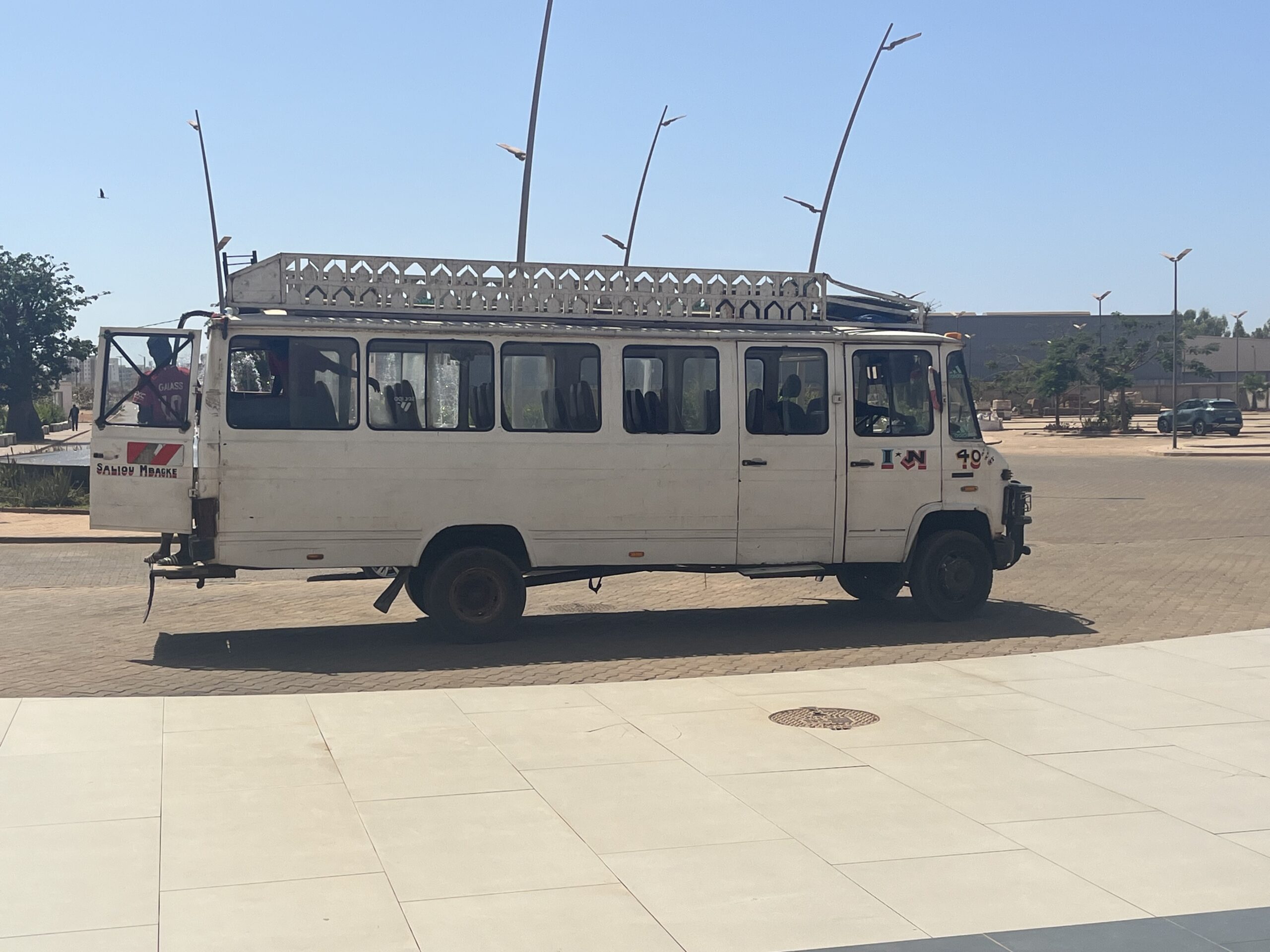
Geertje is inside on her laptop doing some work. At a good moment one of those old Mercedes passenger buses that I have seen so many of, stops. This one is in reasonable condition, not full of dents and all painted up. But with luggers and the typical roof rack. The bus enters the traffic circle and stops right in front of me. Now I can take a picture. It may not be the most beautiful and battered one, but I have it right in front of me. As I take the picture, I hear a lot of cheering behind me and the first children come running around me on the right and left.
I start filming. It’s a big class with masters and teachers and a lot of luggage. They must have been at camp. Two porters climb up onto the roof and one stays down to indicate the suitcases. When everything is on it, a net is pulled over it to secure the lot. The spare tire, which is also on the roof, is placed on the end of the net as ballast. The haulers are the last to climb into the bus, which then drives away. I feel like I have been watching a play. All the waiting was worth it as far as I am concerned.
A little later Serigne arrives and we ride with him to Anaïs’ house in Saly. The drive from the station to Saly takes over an hour (Serigne spent a long time in the traffic jam to the station) we drive through a Baobab forest. This is not a forest like ours, but a sandy plain with the occasional ancient tree. In the rainy season it is all green, but now it is a barren wasteland with trees and the occasional large industrial complex.
The trees are beautiful and so survive because they are old and deep-rooted and need little water. I am reminded of the Amazon where I was a long time ago. They cut down the jungle there to get farmland and left the protected colossal Brazil nut trees, but they cannot survive at all without the jungle around them, so the trip to the forest was a sad mile-long trek where the trees farthest from the forest were the worst off. It was a slaughter!
The Baobabs which are also protected fortunately stand proudly and seem to survive everything. Saly is Senegal’s largest seaside resort and is set against a beautiful nature reserve. We decide before we eat anything to go for a swim. We put on our swimming clothes and leave everything in the house. I put only a few thousand francs and the keys to the house in my pocket.
We walk along the main road (actually all the places along the coast are along that one very long road) with large hotels between the road and the sea. When we have passed the last hotel, we walk onto the beach. We discover that on one side of the beach is the sea and on the other side is the lagoon. It is a beautiful lively place. There are surfers, sailors and, of course, they are playing soccer. Further along the banks of the lagoon to the sea are all cozy beach bars.

Later we discover that you can’t get there on foot because the water from the sea flows in and out of the lagoon there. I go swimming and Geertje stays on the beach reading a book. The water is lovely and all sorts of things swim and fly around me. Just in front of me a pelican swims on the waves, different from a zoo. I get out of the water, dry off and look around me for a while more at everything going on. The trip has taken almost all day, but it is wonderful to be here now and to have our own home. We decide to enjoy going to the house, shower and eat at the local joint that was recommended to us. I feel in my pocket and notice that the key is gone. Now how could I have done that; go swimming in the sea without emptying your pockets (actually, I never do that, I realize, so it always happened to go well). The 2000 francs is still in my pocket, but that’s no use to us now. How do we get into the house now? The panic takes hold a little anyway. Geertje doesn’t even react very angrily, but has the same feeling of elation, even though she already finds it an unpleasant day. We go to the hotel where, after explaining that we have quite a problem, we are fortunately allowed in to ask at the reception desk to look up the number of our hotel in Eindhoven and call them, to ask if they can call Nard, who in turn can call Anaïs, who can then call Serigne. I get Maud on the line and explain what she needs to do and if she would like to call back the number I am calling with when it is successful.
After we have waited a while, I suggest that Geertje stay at the hotel and that I go to the house to see if there is some way I can’t still get in. Arriving at the house, I see the gardener of the opposite neighbor standing in front of the gate calling. After a while, he notices me and asks if he can help. I ask if he knows Serigne, but he doesn’t. In fact, he doesn’t know anyone here. Then a few houses away a white car stops. A woman comes out of it. I try to get her attention and it works. She comes up to us, her name is Pauline and I explain the situation and she says she knows Anaïs, but only has her Senegalese number. But Anaïs is not in Senegal, so that doesn’t help us. Pauline thinks she can somehow get Serigne’s number. I go in with her, she makes some phone calls around the house, we greet her husband who is sitting on the couch and after the last call we go on our way. I get in the car with her and we talk endlessly about everything except the keys. After one more phone call it all seems resolved, we go to the restaurant that was recommended to us and as we talk a bit with the owner there, Serigne arrives. He gets out, has a wide grin on his face and in his hand a dancing set of keys. He was called by us almost at the same time as Anaïs and fortunately has a spare set of keys. I get back in with Pauline and ask if we can pick up Geertje. When we arrive at the hotel, it turns out that Geertje has had a great time and made friends. She has been relaxing on a bed by the pool. I introduce her to Pauline and we drive home. It turns out that the gardener has arrived there as well. He would anyway, to watch over us, spend the night in the shed at the front of the garden.
Less than an hour after I noticed that the keys were gone, we are back home in peace. We want something to eat and even though Geertje didn’t think the place we know by now was very clean, we go there to eat. It is cozy, the food is simple, as I said, but fine. I think it is the best prepared fish so far. What is especially noticeable is that the pace in the village is much slower. We eat and look around at what is happening at a slow pace. A store owner who has been napping in the doorway since this afternoon when we arrived wakes up and brings in the display case of jewelry. The other stores are closing as well.

They probably live by selling to the hotel guests who occasionally come out of their resort to take a walk and buy a typical African souvenir. Further on, people are playing bocce on a lighted court. We head home and resolve to enjoy the rest and do nothing tomorrow.
When we wake up, we go to do some shopping, which is not easy. Again we are fooled by a vendor who pretends to own all the stores and ends up selling us four mangoes that don’t belong to him for far too much money. The mangoes and a bag of cashews is what we feast on until the evening. We don’t feel like shopping anymore, also because the stores are very small and have a small selection. They are, however, the tastiest mangoes we have ever eaten.
I app with Pauline to thank her and maybe have a drink together. We meet nearby at one of the older and beautiful hotels. Pauline knows the bartender and people who happen to walk by. She is cheerful and energetic and gives something to a man who clearly does not have much money. Later she tells me that she gives to whomever she wants, and I understand that you have to cheerfully wave off and give, which works much better than being overly seriously annoyed or angry. They also beg quite energetically and cheerfully! Somehow we have a lot to discuss. The conversation is lively.
I hear how Pauline had a very tough childhood, came here, met her husband, has children and runs a business making and selling bags to tourists. Despite a not too easy life, she is full of life and bubbling with energy. I was far from able to translate everything, but despite that, Geertje also found it a very nice meeting. In the evening, we went out for dinner at a joint that Serigne took us to. The restaurant that Anaïs recommended to us is expensive and this one is good. It’s pretty disappointing, but like every night, it’s super fun with Geertje.
The following day, before we return to Dakar, we go to the gallery Le Memoires Africain on Anaïs’ recommendation. It is an hour’s drive along the long coastal road where just about everything takes place. Again, it is wonderful to see so much. The gallery is in an old building, downstairs is a lot of old ethnic African art. The owner’s parents had a large collection of indigenous art which created his love for African art. The collection formed the basis for his art business.

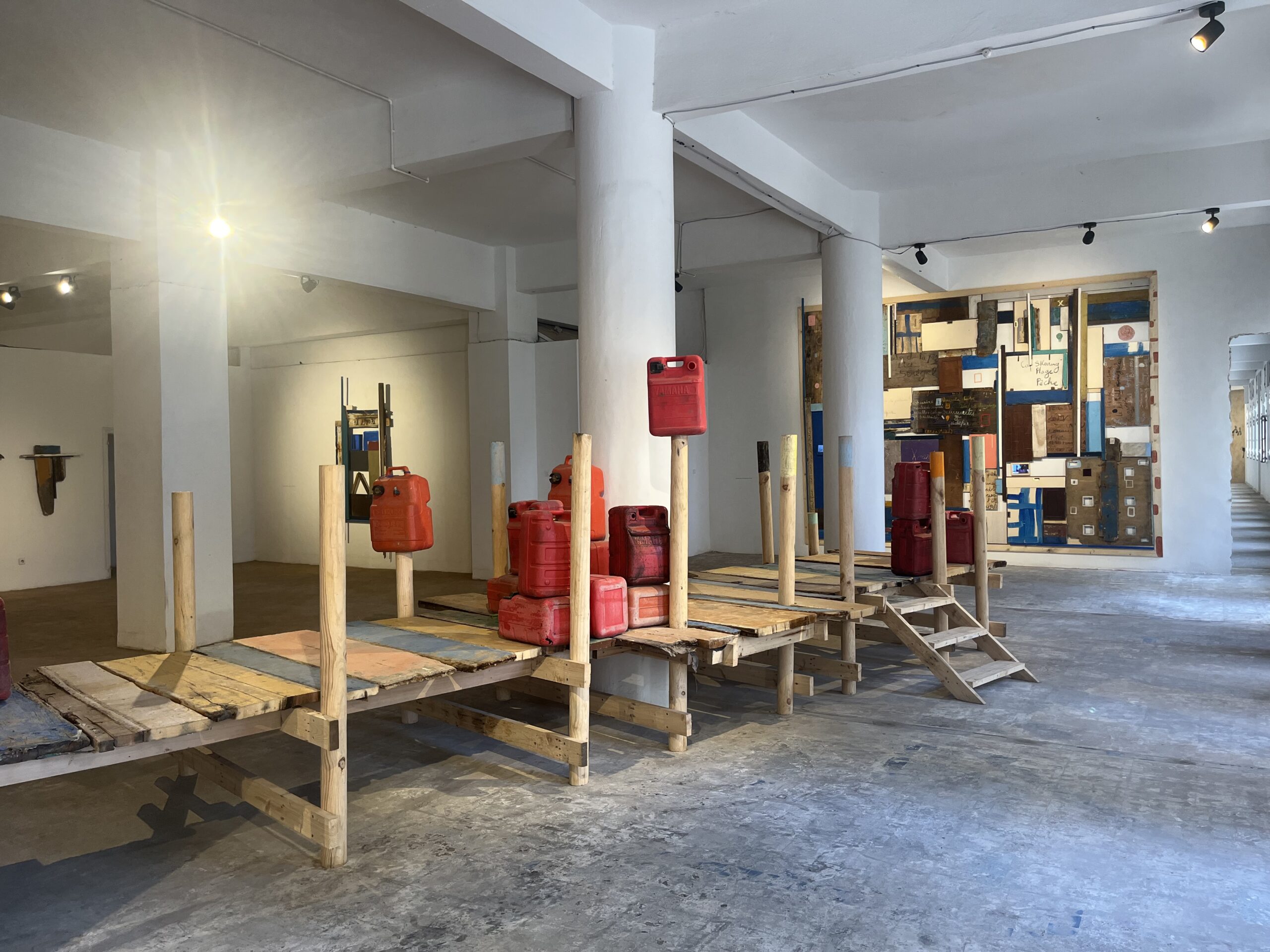
By now, old native art is almost impossible to come by and he has turned to modern art as well. The gallery with upper floors is large, the exhibitions are very nicely curated. Again, there are installations that would not be out of place in a museum. Especially that the building has been stripped bare and that the art is displayed in this rough but quiet environment is ironclad. I buy a small piece there by Jean Marie Bruce, a rasta artist who, above all, wants to make! I discuss with the owner whether he would possibly like to collaborate. He is open to it.
Slowly but surely, I am discovering that while I like typical African art, I do not like the classical. With both old and new art, I like the simplistic work best. It looks like Art Brut, but then it is made by artists who have had training. When we get back, we have plenty of time to go to the lagoon dams selling oysters.
Both Serigne and Pauline said we should try that. It is not far, but quite hot and the walk is long. Geertje finds it tough and wonders if it is worth it. I like it again and despite it being a boring route I see many nice things. The best are two stackable plastic chairs, each consisting of two stacked chairs sewn together and reinforced.
They are works of art that would not be out of place on an exam. Near the water, canopies have been made. There is a breeze from the lagoon, the tables are decorated with tablecloths and plastic nailed over them. They are apparently different trades, because the ladies do their best to get us to join them at the table. We choose to sit under the canopy. The ladies are from a village on the other side of the lagoon and have a license to grow and sell oysters here. Senegalese French is even more complicated to understand here, fortunately there is one lady who can just speak French.

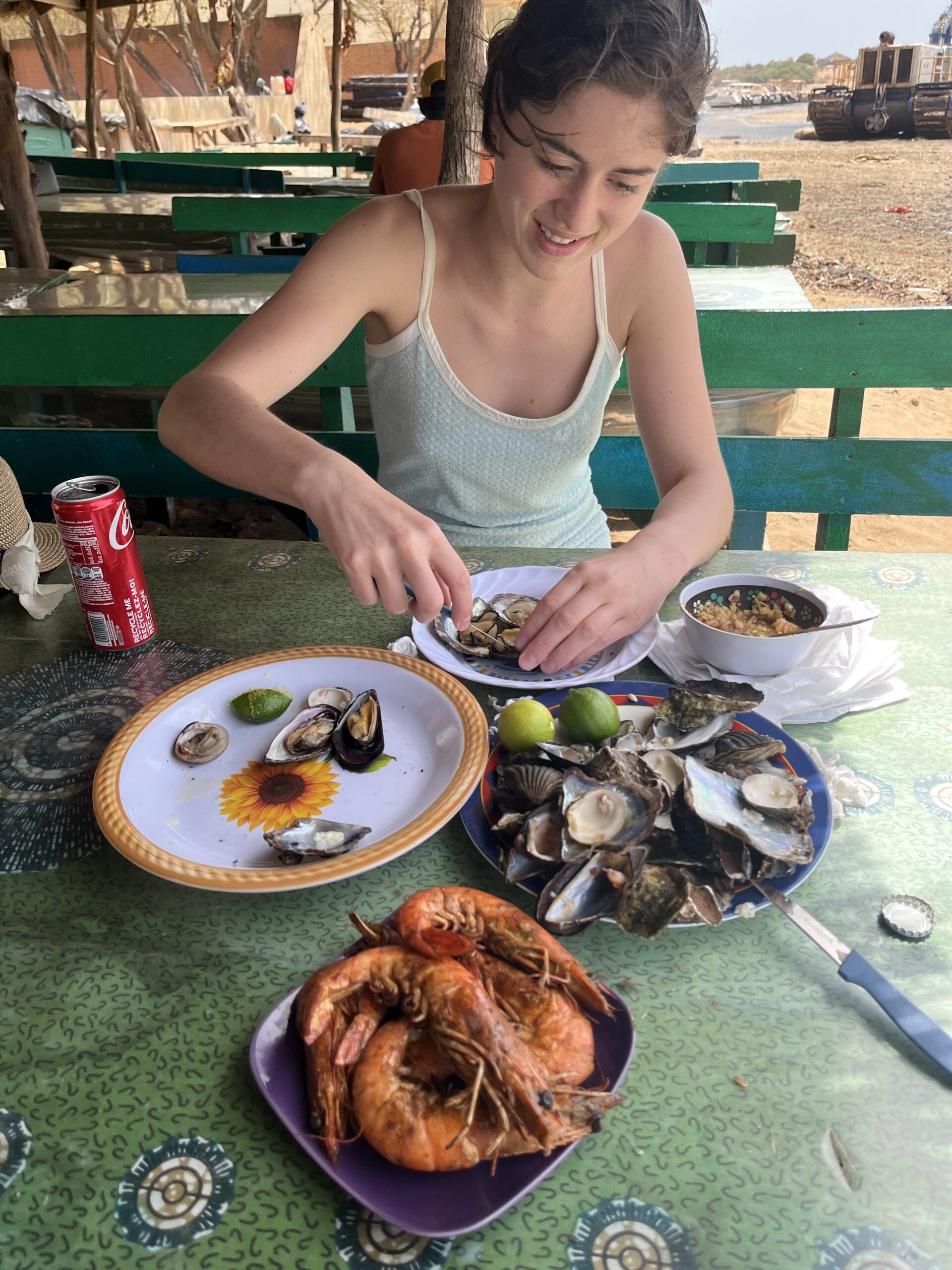
She arrives after conversation with a plate of everything they have. In addition to oysters, they have three kinds of clams and langoustines. We order a mix of everything. They also appear to have beer and soda against our expectations, so we order a beer and Geertje would like a Coke because that seems to help if you eat badly and might get diarrhea.
She is not entirely comfortable with the hygiene at the little beach. I tell her that at least it’s fish that only needs to be taken out of the shell and into the fire, so not much can go wrong with it. Slowly the little tent fills up, which is reassuring. When the first scallops arrive, Geertje is completely won over. They are scallops we don’t know, they are roasted on the fire and there is a fantastic smoky flavor to them like we have never tasted before. The tastiest scallops ever, in the beach spot that was so unsettling at first. I tip, the ladies are super happy. In retrospect, I think they had already asked for way too much and didn’t expect to be tipped even then.
For us, it was inexpensive and, above all, a great experience. As the ice is broken, they tell all kinds of things about themselves and their little business. The walk back is just as long, but because we are so happy, it feels much shorter. In the evening we have to be back on time, because we have tickets to see Cheir Lo at La Mer a Table. I have several of his songs on my playlists so I’m looking forward to it immensely. The concert is a bit disappointing, mainly because the sound is only halfway okay. Kind of crazy, since he performs there every Wednesday, so you would expect it to be routine. By the way, the musicians are exceptionally good and the ambiance with the music is great. Tomorrow we will look for record stores in addition to galleries.
Record stores
By now, we manage pretty well to think of where we want to go in advance, and Bassirou understands roughly what we want. I type into his phone the destination, because with his phone you can navigate. Again we see a lot of galleries. The highlight is again Le Village d’Art where we check out the rest of the village and again discover very nice art and artists.
The record stores are a little harder to find. The first one is at an address that is hard to find and once we get there, someone points us to a door, but when we go in, there is nothing to discover. We try the next address, it too is hard to find and turns out to be on the other side of the block. The business is called Buffalo Soldier Record Store Vinyl. The little store, I think, is less than six square meters in size (2 x 3 meters). The soldier sits on a chair with a stereo in front of him and around him are piles of records.
So they are not standing upright in cabinets which would allow a lot more to fit, you can easily access them and classify them, the latter is apparently not necessary, because when I ask for some, (Orchestra Baobab of course, but also Balla et Ses Balladins) he picks out a stack among a tall pile and there the titles indeed appear to be.
Using the first records, he pulls out some more. We listen to the records which are pretty old and creaky. He thinks they are fine, they just need cleaning, but he has run out of his cleaning stuff. I ask about the price and am surprised. After considerable bargaining, they are about 40 euros each, which is much more expensive than at home and then the quality is also questionable.
It does include records that are not available in Europe, but still 40 euros is way too much. He doesn’t want to drop the price. I am actually fine with it, it was a fun and crazy experience and without a purchase I am also fine with it. We ask Bassirou to take us to the hotel. The rest of the afternoon we stay near the hotel. The Institut Français is the main goal, we can have lunch there and they also have a record store.
Meanwhile, I have a new ritual with Bassirou when it comes to paying. One of them gets to make the price and if one is matched the day before, it’s the other’s turn the day after. He plays it much better than I do and has negotiated a kind of base that is very good anyway. And actually, by now we are quite happy with our regular driver. The Institut Français is located in a courtyard, to get there we have to go through security. Once inside, it is a very nice place with lots of greenery and a large canopy with the restaurant under it. There are fans hanging everywhere.
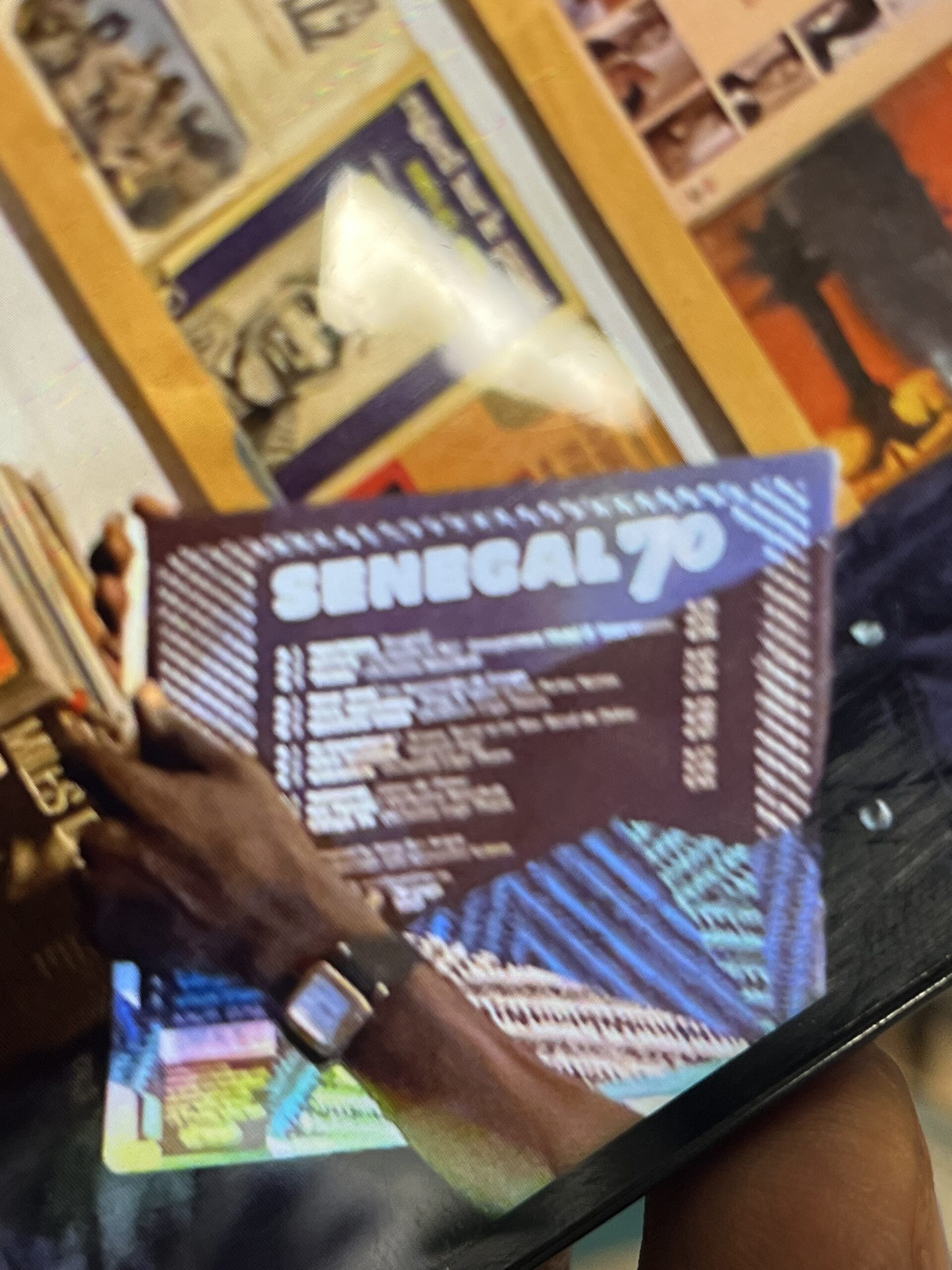
It’s probably very hot there in the summer. And there is a record store. We are going to eat something first and then I am going to look and listen to records. The guy who works there is extremely nice and knows a lot about music. I end up buying 3 or 4 records for about 15 euros each. The nicest one has paper tape on the edge from a cover that got wet once and dried again. I think, that should be able to come off and take the gamble.

By now we have seen and done an enormous amount, not at all what a tourist would do. In Saly we experienced all kinds of things, but saw nothing of the nature reserve, and in Dakar we visited dozens of galleries and a few record stores. We were told by almost everyone that we should at least go to La Gorée. The name dates back to Dutch times when the Netherlands traded big in slaves. Named after Goeree Overflakkee, the little island off the coast of Dakar served as a transshipment point for slaves leaving on boats bound for America.
Bassisrou actually wants to join us, but I make it clear to him that we enjoy being on the island together. He doesn’t seem to care much anyway, and instead of going out to do something or to work, he just waits in the harbor for us. Then he is at work too, he will think. We buy tickets that are twice as expensive for tourists and then find out that we are not allowed into the building. Classes of children and local passengers do walk in.
Once we are allowed in, we must first sit down in an anteroom. Still people walk through and apparently go directly to the boat. At one point I am sure we have missed the boat and so we have to wait for the next one. Geertje is cranky and actually wants to leave. I don’t really care, as long as we get there and find it funny to pay twice as much and be treated worse. Shortly thereafter we are allowed into the terminal and there is also a store where we buy some food and drinks.
La Gorée is just off the coast, but the boat trip through the ports and a small stretch of sea is another experience. La Gorée is beautiful. The arrival is idyllic, at the foot of the old fort on the beach, almost naturally another boy is playing soccer against the walls. Not only is the fort still standing, but many of the houses and buildings erected a few hundred years ago are still there. Most are poorly maintained or in disrepair, but what has been refurbished has been done with a sense of history giving the village an authentic atmosphere. It is beautiful there, but on the other hand, its horrific history is emphatic.
When we are allowed into the museum (which is allowed at set times) and wander through the slave trader’s house and see where the slaves stayed before being carried off to sea through a door, we realize that it would have been nicer if the island had not had a Dutch name. The exhibit has a lot of text, which I always like, and is beautifully designed. What I find most gripping are eyewitness accounts of people being exploited today, “modern slavery.” The building is painted in Barragân -like eye-catching colors.
Once we are out of the museum, we walk through the village. The houses and buildings on the other side of the harbor (that is, on the side where the mainland is) are dilapidated. As we walk through, we see that in the ruins of one of the large buildings is a garbage dump, but also that a little further on, shacks have been made against the old walls of dilapidated buildings. Presumably it would have been less work to make or repair a roof on the ruins, but still prefer a shack.

We pass a soccer field with artificial turf, bleachers and two goals. There is no one playing soccer, unlike the sandy field in the middle of the village a little further on. There are two goals, one of them half around a tree and halfway and in the middle of the field is a large Baobab around which soccer is apparently played. There is a large group of boys on the goal on the other side of the tree shooting at goal. We walk on and in the ruins of one of the buildings we discover a gallery. I love ruins, so for me it is a highlight. On the outside wall is a sign that says “exposition” and a phone number. In this case, inside is also outside, as there is no roof on the building, but the walls are still standing nicely and the artist has nailed his work to the walls.
On the ground is the material he works with. Most of the works are sort of primitive masks, the kind of work I like best. The artist is not here, so we walk on. Around the corner, more of his work hangs in three window niches. There it says his name: Djibril Sagna. The island is actually not ruined at all. There is beautiful and well restored and the rest is dilapidated but original. It occurs to me that if you really have a lot of money and want to do something well, all you have to do is figure out what you want or can do with it, make sure it is refurbished and exploited and then sell it to those who exploit it. Then it doesn’t cost money and you can do the same thing again somewhere else.
At the end of the day we sail back. Bassirou is lounging in his car. He takes us back to the hotel. In the evening, we go to eat again at Seku Bi. We had the best food here and the atmosphere is wonderful. In front of the door we run into the French banker again. He is with a girlfriend who is clearly upset. She has just been almost robbed, she was just barely able to grab her purse with two hands, and the thief who was on the back of a scooter passing quickly finally had to let go. I now realize that the day before a scooter drove straight at us and that I said to Geertje that I wondered what possessed the man.
Today is our last day. We leave tomorrow around noon, so we decide not to do too much. Bassirou has offered to go with us to the city’s largest fish market. When we get there, it turns out that tourists are not allowed to enter the market. We wait in the car for a while as he tries to arrange it. The first thing we hear is that we are not allowed to photo-graph and then that we have to buy fish and so we are not tourists. Bassi settled it. At the market I can understand why they don’t want photography, it is huge and there are fish on wet pieces of cardboard on the ground everywhere. Ee are no smooth materials that can be easily cleaned and ice and water are also scarce. At the end of the day everything is just sprayed clean I think.

But it’s wonderful, there’s a wide variety of fish being cleaned and prepared in different ways. As we walk out the back right under the huge concrete roof, there is a kind of market there with stalls selling dried fish. It’s a beautiful sight, I want to walk up to it and step into a gutter of fish juice and goo. Geertje and Bassi, who is walking on flip-flops, jump over the gutter. The crazy thing is that Geertje doesn’t seem all that concerned about how dirty it is, even though this is the most questionable area we have been to date. It will take a few more days and cleaning before the shoe no longer smells like fish. The dried fish market is quite large, every day all the fish go up, as what is left is dried, fermented, or otherwise processed. Now we still have to buy fish not to be tourists. Geertje has figured out which ladies she wants to do that with, but we have to look for a while to find where they are again. When we find them, Geertje is very happy, the money is well spent. But what to do with the fish? We tell Bassi that we want to give the fish back to the ladies once we get past the porter.
He makes a deal with the older of the two. So they got paid and they get the fish back. When I discuss this, Bassi tells me that they have to hand over the money to their boss, so the fish they get back is actually their payment. The lady is very cheerful, inadvertently we did what Geertje wanted.
On our way back from the market, we stop by the largest modern museum. There is a mix of ancient, ethnic and modern art on display and it is all together again very beautiful and inspiring. The rest of the day we lounge on the beach and enjoy the sea a bit. It’s Saturday, so a lot busier than previous days. The lifeguard is lugging around beds and mattresses like crazy.
We now see why everyone has a bed, because at mid-day there is almost no beach and the beds are in the water. It is a mixed crowd, yet the lifeguard is keenly watching to make sure no swimmers from the other side of the pier get into his water and onto the beach. At a good moment, a young woman swims gaudily under the rope with the balls, toward the beach. The lifeguard blows a whistle and walks over to her. She stands up and, with their feet in the water, a fierce conversation ensues. She is clearly super wanton, he does his job and makes her leave again. Geertje thinks it does make sense that they are protecting the beach so it is safe, because there is actually some kind of threatening atmosphere everywhere. I feel much more like it involves both a play and real drama at the same time.
The woman knows best that it is not allowed, but does not want to just accept it and the lifeguard understands her best. They are both dark and in the end it is about inequality between white and black. These days it’s rich and poor, but unfortunately that’s almost the same divide. His job is to keep things separate and she denounced it. At the end of the afternoon, before we eat, I want to check in and find that I can’t. I look at the tickets again and see that I was mistaken. We are not flying at the end of the morning, but only in the evening. So we still have almost a full day tomorrow. Since we can sleep in, we decide to go once more to Trames, a gallery with a kind of club restaurant on the roof. The building is on the edge of Place de l’Independence. On the roof you have a view of Dakar.

There is an Italian party, a large group of Italians is slowly gathering while we are eating (already quite late). Again, Italians eat later than everyone else! One cute guy in the group seems to be kind of the host, playing records on a pickup with boxes. They crackle a little, but it’s fun, crazy, mostly African music. He seems to care little about the cracking, perhaps the norm here in terms of cracking is different from ours. At a good time, I ask him if I can check out his records. Soon we are animatedly talking about music, his life here, the evening itself where his girlfriend is the cook, that he studied in Wageningen and loves the Netherlands.
I talk to him about the Buffalo Soldier, he tells me that Pharrell Williams visited him once and bought all his records and that he has been very expensive ever since. Kind of funny, because not too long ago we sold Pharrell Williams the fanciest table and chairs we ever made! Prices haven’t gone up with us, by the way. At a good time, his friends come and get him a little irritated, he is having a night out with them, right? We keep looking for each other during the evening anyway. Finally two men he has been in contact with arrive. They are record dealers, they come from a few villages away and so one of their trades is buying records and selling them again. We start listening a little bit and I feel burdened, because they actually come to sell records to my brand-new Italian friend.
He says he doesn’t need anything, so I decide to buy some anyway. The manager of the tent has already walked by a few times and addressed the record men. Now he arrives a little angry anyway and asks if they want to leave. The men pretend to know nothing about it, but later I understand that they know very well that no sales are allowed to guests. The manager is aware that foreigners in Dakar are besieged by salesmen and feel permanently embarrassed, and on his roof everyone should be able to be relaxed.
I think he is right and thank him for his concern. I do go home with some awesome records that again I don’t know how they will sound. The next day we do it all relaxed. We walk around downtown some more, eat some food again and withdraw money to pay for our last ride. Bassirou, our cab man, takes us to the airport. It’s the first ride I know what it’s supposed to cost. We drive away and for the first time the streets are quiet. Even the first stretch toward the station, which is normally impassable, is empty. There are some stalls open, but most are closed or completely gone. And there are hardly any people. I ask Bassi where the people are. He tells me it is Sunday and so everyone has gone home. Most people have homes outside Dakar where they stay on Sundays and holidays. So all those people I thought were living on the streets have homes.
On the plane, the processing of the trip begins. I had hoped that through this trip I would somehow find leads to work with African artists and artisans. We saw lots of art and artists and met fine people and found a few products that might be worthwhile. And we met Pauline and somehow I think and feel that we can work together, that she understands what animates me. The idea to initiate “The Eindhoven Dakar art and design rally was born.
« Back to blog