


So in June 2024, I went to Dakar with Geertje. The accident I seemed to have when I lost the key to the house in the sea now turns out to be one of the happiest accidents of my life. Because of the key I met Rama and she makes the Eindhoven-Dakar project possible.
When Geertje and I are back home, the adventure really begins. I can start designing, thinking about which art and products we can buy and show. Rama is going to help me realize all these plans. To start, I want to write a piece about my first trip with Geertje. Because I want to explain with the blog what drives me and what I am going to do, the whole experience suddenly becomes important and it becomes one of the longest (and most boring) blogs I have ever written. I have the idea that the smallest details are important because Dakar is a world that is in no way like ours. Most of what we have and find very important, they do not have there and yet you see friendly and happy people everywhere. (They do have a lot of sun, which may also help). Writing the blog in between takes time and sending it, because we are busy with the DDW and many other things, does not go smoothly either. In the end, we will send the blog months after I am back, after the DDW, but luckily just before I leave for Dakar for the second time. I assume that the blog will be read just as little or even less than usual. Which is true, because in my direct environment the best reaction I get is that I went to Dakar and a blog was sent (and that it was long). But the blog is read by Hans van Bentem, an artist we have worked with for a long time. We have had a great “glass lion chandelier with a dick” by him hanging in the office for years. He sends the blog to his friend, Erik Pol, who has lived in Dakar for decades and has a woodworking shop there where sculptures and objects are made. Erik is one of the founders and namesake of Pols Potten. I get in touch with Erik, we agree to meet and he invites me to come and have dinner with him at the embassy in Dakar. The few people who have read the blog are exactly the right ones! That is funny when you consider that the truth or the judgment of whether something matters or not is expressed in the number of followers these days. My theory is always: if you have one follower who buys everything you make, it’s better than 1,000,000 who just watch!
So now I have three contacts in Dakar; Bibi Seck, the designer I met on the first trip, Rama who I met by chance, and Erik who I met through the much too long blog.

Tweede keer Dakar
On Friday afternoon, November 22, around 5 p.m., Laye picks me up from the airport. In the Netherlands, it is already evening, but here it is an hour earlier but the sun is still shining and it is around 30 degrees. I realize that it is light for hours longer here, that I have never had any trouble with the winter in the Netherlands, but that the warmth is still nice now. Laye is the driver of Rama’s husband’s company. I ask him a lot of questions, as I do with everyone else, and try to find out as much as possible. It is great fun and he turns out to be crazy about Rama, to whom he owes his job. We chat non-stop. Later, when I tell Rama that Laye is nice, he turns out to have told me that he likes me too and that it was fun, but that he understood very little of my French. Rama says that she has gotten used to my French by now and that it is going really well!
The first two nights I sleep in the Africa Queen hotel by the sea near the house we rented from Anaïs last time and therefore also near Rama. It is a fairly old hotel. “This time” I mean that positively, because it is well maintained and has a bit of an old-fashioned colonial atmosphere. The town is touristy and of all the places I have been, the coastal strip from the lagoon (Unesco heritage) is the most developed and closest to what a European would find acceptable. I find it much more interesting without paved roads and when it is a mess. In the oldest, most authentic and atmospheric part of the town, where the locals also live, Rama opened her boutique more than a month earlier. Before that she also had other shops where she sold African products and fabrics, but mainly her own bags. She designs herself and produces with local craftsmen. Rama is therefore used to working with producers and to buying.

Saturday morning Rama comes to pick me up to visit the Dakar Institut of Design. It is a training and production place where they dye, weave and process yarns. It is mainly about fashion fabrics, but they can certainly do something for us and the men we talk to are very nice and modern!
On the way back we visit an aunt of Rama. She lives in a neighbourhood that is permanently under construction next to a fishing village. “Neighbourhoods that are permanently under construction” and even entire villages and cities seem to be the norm in Senegal. I love it; always in motion and never finished. It is not exactly a quality that is generally appreciated. Amsterdam, for example, has been the same for centuries; everyone thinks it is beautiful, but I find it deadly boring! The aunt lives there with a few families (family). We sit in the living room. This weekend there is also a nephew who is studying film in Thiès. He is a super nice young guy who tells all kinds of things and actually has a lot of creative ambitions. I try to give advice in my best French to especially invest time in the direction he wants, so that, if he becomes successful, he will at least do what he likes! I have the feeling that we understand each other. Afterwards we all go to the beach near the village where the residents sweep and rake their sand garden and the children play in the surf.
We also pass by an interior design shop. Shops are often destinations that you need to know and that certainly applies to this one. It is a house completely furnished with products that are mainly made locally. The owner sells the largest quantity in Europe and has his trading company in Belgium. The items and the shop are less interesting than the fact that the shop mainly has a right to exist through the combination of direct sales and export.
At the end of the afternoon we meet Mambeye, one of the artists from Village d’Art from whom I bought small works with Geertje. Rama then contacted him and obtained quite a few other works. In addition to Mambeye’s work, we also have work by Djibril and Iveke. Mambeye is married to An, a Belgian woman. They live in Saly (Somon) on weekends, which makes it easy for us to meet. He is a quiet, modern young man who lives for his work and understands very well how the world works. He has seen who I am and what I do on the internet, which worries me a bit, because it is certainly not the case that entering our world is a key to success, even though it seems fantastic on the internet. It is exactly what I would like to achieve; selling the work of artists and craftsmen and offering them a stepping stone to more. The latter is more important than sales and fortunately has been successful before. So who knows, I might be able to meet expectations, but now it is better to temper it.
In the evening we go to the hotel where Rama has arranged to meet his friends. There is live music, dancing and Mambeye and I drink beer. In Dakar I like beer, I drink Gazelle because of the label. I go to bed quite early. Tomorrow we have a busy program to end in Dakar, where the biennial is now and we therefore have a very full agenda. Rama has reserved the whole week to go to exhibitions with me, but also to visit artists and craftsmen that she has contacted in the meantime and to visit his craftsmen and factories with Bibi.

Sunday November 24th
The next morning our goal is to visit a man who makes rugs by hand in Thiès. We could use the rugs for beanbags. On the way we also pass a shop where they sell baskets (paniers). They are well-known products that are sold all over the world and are therefore also made here. Because the owner of the shop also produces the baskets himself, Rama wants to show me. The shop itself is a kind of sea of baskets and really worth it. Actually I had not planned to design baskets, but now that I have seen this, it seems like a good idea. When we arrive in Thiès, after a lot of calling and hassle we stop at a crossroads where at one point a man on a scooter comes to pick us up. It is the man who makes rugs. Driving to his studio turns out to be too complicated without Google Maps and maps. He has his studio behind his house which, as usual, is made of unfinished concrete blocks. He shows us his weaving machine and explains why and how it is different from regular weaving. If we want to do something with it, we have to make designs on a pattern, which is actually also challenging and fun.
Rama has decided to visit a wildlife park on the way back. We are driving Rama’s old 4-wheel Toyota and Laye’s. He has never been to the park either. We pick up a guide (which is mandatory) and drive through an African landscape. The guide knows more or less where all the animals are and even though I didn’t necessarily need to go on safari, the animals are still really impressive. How a zebra can have stripes under pressure from natural selection as if someone has gone over it with a paintbrush is amazing. Yet it turns out that my great love goes out to trees. The Baobabs that are here are enchanting.

Monday November 25
On the way back to Dakar we stop by Erik’s. I have not communicated enough and just as we arrive, he takes his daily dip in the sea below. The carpenters are there and we take a look around anyway. About 50 meters behind the gate are the workshops and the terrain towards them is littered with tree stumps from which they carve wooden objects. The solid wooden stools and tables that are sold by Pols Potten all over the world are made here. The stumps are beautiful and my first thought is to use this as a starting point (less work and more character) instead of thinking of shapes in which the bark and the shape of the trunk disappear.
Next we visit a plastic injection molding factory. The owners are Lebanese. In Senegal it is normal to mention the origin and sometimes religion of the owner (often an entire family). The idea is that if you know where someone comes from and what they believe in, you know what kind of person they are. Furthermore, as I have written before, hardly anyone is fanatically religious and there is hardly any enthusiasm to impose your beliefs on someone else. You let and respect each other and can therefore also explain. Now that I am writing this, I run the risk of missing the point because ethnic conflicts are not an exception in Africa and the first time the Biennale was postponed because of the tensions surrounding the elections. But Senegal is known as a stable and above all tolerant country, that is also how I experience it and everyone confirms it. This is also a crazy sentence, because Africa is 3 times as big as Europe, so it is nonsense to tar Senegal with the same brush as the rest of Africa, but it is quite logical to see Africa in relation to Europe; complicated!
We are given a tour of the factory where a large number of relatively high-quality injection molding machines are located and buckets and other plastic products are made on an assembly line. Some products are quite beautiful, especially the colored plastic whistling kettle-like kettles that are used at the toilet and on the street to wash your bottom and hands, are brightly colored. But we are looking for the thick-walled terracotta-colored recycled plastic buckets that are pressed in simple molds with low pressure and temperature. It is not the first time that we hear that we have to go to the Dia family for that and we get a phone number from another descendant. After a very hospitable welcome we get back in the car and Rama immediately starts calling. It turns out to be almost impossible to get in touch with the Dia family.
In the evening we go out for dinner near Almadies, a part of the city located on the coast, where Rama used to live and knows her way around well. There are an incredible number of restaurants and clubs along the water. It is wonderful when you are with someone who knows where you should and should not be. Also “Mer à Table” where we saw Orchestra Baobab and beautiful wicker lamps! Rama called the restaurant and found out who makes the lamps. The man is called Dramé and it turns out he makes much more than just the lamps. When I heard that I immediately made some designs. Rama discussed the drawings with Dramé and he started with a rattan lamp. We have a drink at a restaurant while waiting for Dramé who will come by with a prototype of the first lamp. He shows up much later than agreed. An appointment is not exactly an appointment and it is not an exception. So it is necessary to be very quick and assume the worst without getting frustrated. Rama proves to be a master in the strict but fair approach and she regularly says that it is better not to trust anyone when it comes to money and agreements. The amounts are not too bad, so I am prepared to take the risks, but Rama does not want that and she is right, because if it goes wrong and you have to say goodbye, you will not only lose your money, but you will have to start a process all over again. So it is better to make sure that the process goes as smoothly as possible. Dramé only has a frame of the lamp with him. Quite special, because the design has no frame at all. It is also made of very thick bamboo that is not in the design at all and the shape does not correspond to the drawing. Sending a drawing and then having it made is therefore not a given. He is a surprisingly nice man and because it is not good, he is going to make it again. We do not yet know that a large number of failures are needed to get somewhat in the right direction.

Tuesday November 26
In the morning I only meet Bibi, Rama is at a funeral. We go to Modou and an aluminum foundry in what you could call the steel district. The main street of the district is known for the puddles of sewage that usually stand there. The street is the lowest part of the district and because the sewage doesn’t work well, the water often comes up. It smells, but it doesn’t stink, so it’s not that bad. We first go to Modou the steel man. His workshop is, like all workshops, mostly on the street. There are a few goats in the sand and they only have an angle grinder and a welding machine. Because it is a steel district with everyone’s specialty, they don’t have any stock. A little further on they get what they need. We discuss the drawings with him and determine the price to make a first prototype. Then we go a little further down the street into an alley with workshops on either side. In the front are the products that are made in the alley with workshops. The lion’s share are barbecues and stacks of aluminum pans. There are many craftsmen working here and there in all the holes and corners. Most of them are squatting on the ground. Instead of cutting or slicing sheet metal, they use chisels to hammer the shape they need out of recycled, straightened sheet material. The barbecues are made from half barrels and parts are made. I am most impressed by a part that is made from a 3 or 4 mm thick angle profile in which three holes are punched by hand. They punch the holes by hand by using a hammer on a pin to hammer through the material into the hole below. There are three holes in each profile of about 15 centimetres. The puncher has dozens of them lying around and punches the holes as if it were nothing. All sorts of things are happening; bowls are hammered out of straight sheet metal, ornaments in the shape of flowers are hammered with hand tools, materials are separated to make something new, forging, in fact everything that can be done by hand with steel is done in the alley. We arrive at the aluminum founders and hand over the form of a bowl that we had printed in the Netherlands. It is a fairly slender design and I doubt whether they can make it and Bibi rightly has his doubts about the release properties. At least, it is certainly not release, but perhaps they can solve it with a trick. We discuss what it costs to make a prototype and when he will have it ready and leave the bowl behind.

Then we pass a shop where they sell products made from recycled plastic sheet material. It is actually a kind of pilot store of the manufacturer of this sheet material. Bibi has already developed quite a few products with them and it seems that it will be quite easy to start working with them. Then Bibi takes me to a beautiful local restaurant in the center. A long time ago, the restaurant was started by a woman behind a house in the courtyard. There is a sign at the cash register and as far as I understand it has remained unchanged. You can order typical Senegalese dishes there. They are mainly fish oven dishes and the portions appear to be more than sufficient, to say the least, which is the case everywhere. Rama has torn himself away from the funeral and is just in time for dinner.
After lunch we go to the old Palais de Justice, where the main presentation of the Biennale is organized. It is a great colonial building that was nominated for demolition for a while, but the quality of which is now recognized. Although the question of whether or not to demolish it may not be about quality at all, but much more about the discussion of whether the colonial past should be erased or whether you should see it as part of the history of the country in which the good can be preserved. The building is great and so is the art! There is even a wing with design. The Biennale offers what I hoped for; a broad view of what is going on in Africa in the field of art and therefore in reality. Where the horrible situation that has arisen because Europe has concluded fishing contracts with the authorities, as a result of which local fishermen can no longer provide for themselves, is a recurring subject. The art is in any case largely committed, which is logical. The rest of the week we go to as many presentations as possible between visits to craftsmen and companies. One of the most impressive, in my opinion, is a film by an American artist. Using old camera and film footage, he tells how, as a child, he understood nothing of the rituals in the church where his parents (almost) experience religion in ecstasy and how, in his search for his roots in Africa, he discovers almost comparable, lively rituals. His parents did in church what their ancestors in Africa had been doing for centuries. They have adapted the Christian faith to their own ends. Which is a very interesting observation in itself, “freedom to develop your own ritual within the faith” is quite special! The images are sublime.
In the evening we go to Aida and Benoit, friends of Rama. Aida is a fashion designer and has her own brand. They live in a beautiful house on the first floor above the boutique and the sewing workshops. The house is situated around a courtyard with a swimming pool and coconut trees, on the first floor. I know that they are coconut trees because they talk about having to put up nets because when the coconuts fall, you have to cross with a helmet on. The falling nuts are extremely dangerous. It is the most beautiful house I have ever been to. When we drive there, I feel like asking them to stop because there is a strange contrast. The terrain is uneven and there are large beautiful houses on the left and right of the road and in the area where Aida and Benoit live it is very green, but the road is unpaved. So it is an up and down dirt road, with holes and boulders, but here and there are clean, modern, luxury cars parked. It’s a funny thought that the wealthy customers of Aida, who is very successful, find their way to her shop through that sandbox, but here it’s very normal! It’s incredibly cozy, at Aida and Benoit’s there is food and everyone is always welcome.

Wednesday November 27
The next day we have an appointment with Bibi. We are going to a recycled plastic rotational molding company where he already has a number of products made. The technique is simple; you make a steel mold in which you put granulate, in this case recycled plastic, the mold rotates in a huge oven which causes the plastic to melt and stick to the walls of the mold. It is actually two very large rotary machines on either side of a large oven. When one is in to melt, the other is out to cool, unload and load again. The process is constantly going up and down. Bibi is having problems with the seat of a chair becoming dirty and discusses how they can solve this by changing the mold. It is great to see the factory and super useful to be present at the discussion about the problem with the mold.
Then we go straight to the aluminum founder who has now cast the bowl. They solved the problem of the feet that do not come loose by grinding the shape by hand and the ribs are actually too thin for the material and the molds that are used. It has become quite a beautiful object, but not at all saleable. Bibi is in talks to see how and if they can realize it, but I say that I am going to make a new design. In any case, it will be a lot clumsier than the first one!
In the evening we go to the Dutch embassy. Because Erik has lived in Dakar for decades, he is part of the Dutch community. Through him we have been invited to a dinner at the ambassador’s. A few days before, we had already made appointments at the embassy to discuss the plans, get to know each other and who knows, to discuss a possible collaboration for the future. Up until now I have only emailed Erik, so we meet for the first time. It is a very nice informal, relaxed evening on the occasion of a couple who have lived in Dakar for a long time and are now back for a while. Several people have read the blog. I am asked how often and how long I have been to Dakar. I tell them that I was there once for nine days and that this is the second time. They do not understand that we have experienced so much in such a short time. For them, Blog 1 was a feast of recognition. That evening I tell Erik about my motivation and intentions. That I want to buy art and show it here to help the artists, want to design, develop and sell products to give craftsmen work and want to buy typical Senegalese products that I like and sell them here. And that I want to set up a company with Rama that sets up and arranges things in Senegal. His answer is that he tried for a long time, but that it didn’t work, but that doesn’t mean anything because he didn’t have Rama at the time. Incidentally, he does have a great company that makes solid wood products. So if it didn’t work out, it didn’t work out now either!
The last few days we have been rushing back and forth between exhibitions and workshops. There is almost nothing that goes right the first time, but still it goes beyond expectations, because results come quickly. In this respect too it is incredibly important that Rama is present everywhere. She is super clear to the craftsmen and strangely enough I speak and understand what is said and still I would not achieve much myself. She knows what is needed. When we go to see the first prototype of a chair that Modou has made, it is pretty close to what is intended. About 6 details have to be changed, but it is clear that Modou can make the chair. When we come back the next day, it turns out that he has understood almost everything except for one detail. I think we take the chair with us and have it upholstered, but Rama says that if you take this wrong chair with you now, it will be wrong again next time. She asks them how long it will take to adjust the chair and because it will be done quickly, she asks them to do it right away. We witness a kind of artisanal dance between father and son, with the father in charge. They take the chair, bend between pins that are welded to a trestle, straighten the wrong bends and put the right bends in. To get the desired curve in the back, they place the chair with its back on a hollow steel block, something from an old wheel it will be, and with a few good blows it is as in my drawing. To top it all off, they grind out the lower back bar, bend it straight and hammer the same curve in there too. Steel is more expensive than labor, so instead of quickly making a part from a new piece of steel, it is worth the effort to straighten the old part, make it into the right shape and reuse it. In a few minutes the detail is adjusted. We take the chair to Dramé who is going to upholster it in rattan. Dramé has now made a prototype of the lamp and it already looks more like the design, but is still far from what it should be.

On the last day we visit Erik. He shows us his estate where he has lived, worked and built for decades. He has read more blogs after reading my Africa blog. He has discovered that he suffers from the same disease as I do; namely that he cannot stop building. We are given a tour of the workshop again, but then from building to building. I believe there are a total of 5 houses and a few other buildings spread over two large plots of land. The presentation building contains the beautiful sculptures of Hans van Bentem.
That same day we make another attempt to get in touch with the Dia family, the manufacturer of the red plastic buckets. Now we go to the factory itself. Before we arrive, we drive past fields of plastic that is collected and selected there. Dozens of people work among the plastic that is turned over by large bulldozers. Plastic is a valuable raw material and the labor factor is no obstacle to doing something with it, so the plastic is sorted by hand. I don’t speak to the workers. The work seems dirty and hard to me, but it is work, so income and plastic is reused. I don’t know what to think of it. When we arrive at the factory and report, Rama has a story ready. She has called several times, but has not been able to get in touch and that we just came to the factory. It seems to work, because eventually a man comes to us who pretends to be an ordinary manager, but later I hear from Rama that he is one of the owners (the Dia family). He is quite nice, but we are not allowed to see the factory and the process and he actually does not want us to buy products from him either, he is afraid that we will copy his products. Not selling is a bit pointless to prevent copying, because the products are available on every street corner. He is very sensitive to the recycling story and when he hears that I made the first demolition wood cupboard in 1990, he seems to thaw a bit. Much later we hear that the family was cheated once and that they have not let anyone in since then. The provisional conclusion of the story is that we cannot buy the buckets that are for sale everywhere from the factory. I think that if we start buying left or right and it turns out to be a success, we might be able to knock on the door again to buy and if we do that for a while, they will also show us the factory. But we have to try to buy those buckets somewhere.
That day we also do a round along the workshops which turns out to be very necessary, because again almost all prototypes are quite a bit further in the right direction, but not what is drawn. Incidentally, the drawings are sometimes not correct and are totally inadequate for this. You just have to work in centimeters, preferably whole sizes and put the sizes in the drawing as they are measured in the work.
In the evening we go with friends of Rama, who I met earlier, to the Var. It is the (old) lighthouse of Dakar where now also a restaurant and a kind of club is located. Also on this trip I get to experience the great music and dance culture.
This time I know that the return flight is a night flight and that leaving is quite relaxing. We also visit Djibril at La Gorée. Last time I only saw his work and Rama bought 10 of his works based on photos I had taken and now I meet him for the first time. It is again a super special meeting. Not least because Rama and Djibril are full cousins and met because I like his work so much.
That night flight is a bit less when it comes to coming home. I land in Brussels around 5 am and when I get home, it turns out that my keys are gone and Stefanie is not home. Luckily she is awake and she texts that there is a key on her desk in her studio. Eventually I get inside and can sleep for a few more hours. This trip was also incredibly inspiring and this time even more possibilities have arisen.
I can now design the way I like to do it, based on the possibilities that present themselves. This time I went looking for it. I know who is going to make it and what techniques and materials I can work with. Of course it is not as close as in our workshop, but in the end it is the same and if we can work together for a long time, it will become easier and easier. We can now continue with Dramé, Modou and aluminium casters, but we have added rotational moulding, the flat plastic recycling plates, weaving, basket making and Erik’s wooden objects. In addition, we have visited quite a few studios that have not yet been mentioned.
After returning, a period begins in which I work out many new designs and email or app them to Rama. We are also busy further developing the existing designs, which requires an incredible amount of attention. I really want the collaboration to be interesting for Rama from a business perspective, but she doesn’t want to earn anything as long as no profit is made. We do agree that the business model will be that everything that is purchased to be sold with a 50% margin for a company that we will jointly set up in the Netherlands will be invoiced. And the margin is primarily intended to cover Rama’s costs. If you make prototypes as is the case now, that deal is not very good, but with the purchase of art and products it works immediately. We hope that the model will provide sustainable income. For both of us, what we are doing is mainly a lot of fun and the business is not the most important thing!
We are thinking of introducing the project in two phases. The first phase is a kind of image, art and products report of the first trip. We will also show the first prototypes of the designs. In October during the DDW we will supplement it with the first production models that will also be for sale. The first exhibition will take place on May 17
I figured the whole project would cost no more than 20 or 30 thousand euros and we would have developed a lot of our own designs for that, and bought art and products. So if in the unlikely event we don’t sell, we will have beautiful art, very nice products and more importantly, a great experience. In fact, it’s already a smashing success!
Slowly but surely it turns out that we are making so much that it is necessary to go to Dakar again. I don’t like traveling that much, but that does not apply to this destination and reason! On January 28th I fly to Dakar again to look at results with Rama for more than a week, give instructions and start the development of new products.

Third time Dakar
Tuesday January 28
Erik has offered us to stay in his apartment in Dakar. Rama rents a studio 20 minutes walk from the apartment (if you walk well) so that we both have some time for ourselves. The apartment building is on the Rue Tolbiac, an incredibly busy commercial street. Erik warned me that it is very lively there. There is a mosque nearby where prayers also come out at night, a police academy where the day starts early in the morning with marching songs and roll call and the building borders on a very busy street. I love it there. Every evening after I have dropped Rama off in the taxi, I walk back through the city. The first time I get lost because I don’t know the way, but the same thing happens every day because I am looking around. After a few days I walk past the door I have to go in, as I do every day, this time distracted by a young boy doing a wheelie on a scooter. From a dark corner of the street where someone apparently sits every day, I hear “monsieur, monsieur …” He points out that I have walked too far. I thank him and say that I walk the wrong way everywhere and that I love it. He has to laugh. It must have been after eleven, because the street is still too busy for doing wheelies.
The first night is a bit of getting used to and especially deciding to sleep with the window open, which keeps the temperature good but also creates more noise from outside, or with the window closed and an air conditioner that squeaks and creaks. The window open turns out to be the best option for the rest of the week.
I have been in contact with Bibi to make some arrangements, but he seems to think more; when you are there, we will arrange it and go on our way. When I app that I have landed, we make an appointment to come to his studio the next day, after we have visited all the studios.
Wednesday January 29
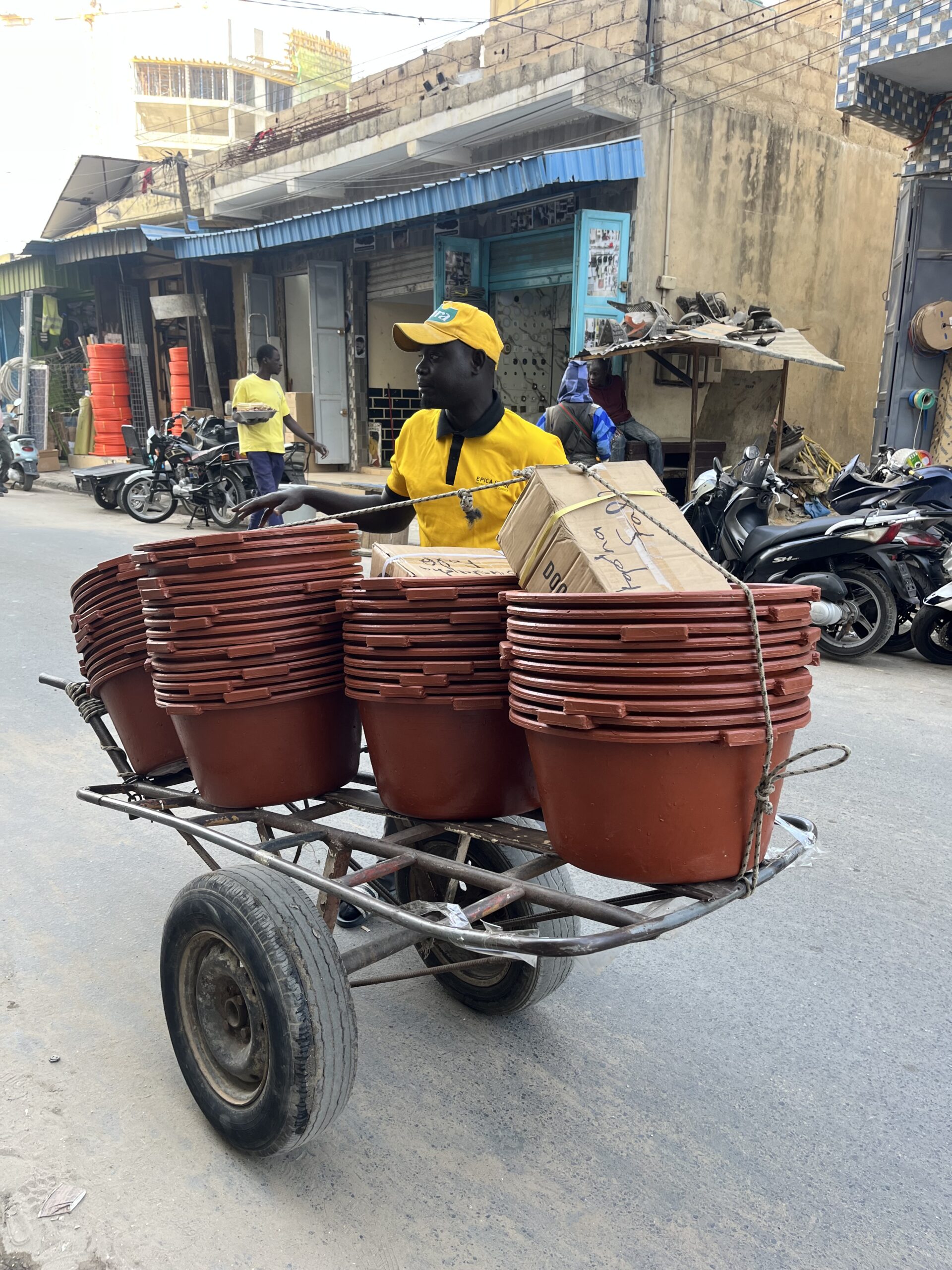
The next morning we set off early to visit all the craftsmen and start up as much as possible, so that we can see results the same week. When we walk out of the apartment onto the busy street, the first thing we come across is a pushcart full of red plastic buckets. Rama asks where he bought them, there is a wholesaler just down the street. We can’t go looking right away, because we have an appointment at Modou and Dramé, and we want to take the new molds for aluminum products to the foundry. Modou made parts of the tube armchair and a beach chair. He couldn’t continue, because the drawings are not clear. We sent him a photo and technical drawings of a similar chair as an example and a pencil drawing that I made last. The last drawing is correct, but he mixed it all up a bit. That’s not strange at all, I think that if I had arrived at our factory with this information, it would have gone wrong too. The conclusion is that I need to pay much more attention to simple and correct information. We discuss how he can proceed and when we will come by again to view the products and hopefully take them with us to have them upholstered. Then we go to the aluminum founder. We show him the new models and ask if he can make them and what the price will be. Rama negotiates quite a bit and we agree on a price. She actually still thinks it is too expensive and tells me that she will try it somewhere else later. Then we go to Dramé where we are shown another new and incorrect version of the lamp. It turns out to be terribly difficult for him and in this case the drawings are actually correct. I have a 1:1 drawing with me that he can make a mold of, so it should go well. We leave and agree to come by again during the week when the lamp is finished. In the afternoon we go to Bibi. We discuss with Bibi what we are going to do this week and also that we have taken the molds to the aluminum founder. Bibi thinks the price we pay for 5 products is fine. It turns out he has an appointment at the rotation molder in two days and we agree to go with him.
Thursday January 30th
Today we are leaving the city. Rama has arranged for us to take the TER (Train Express Régional) a new train connection for the first part and for Laye to pick us up at a station. I think the train is fantastic because there is so much to see. Apart from the passengers who are constantly getting on and off, the suburbs pass by without you having to do anything. And a different place or direction means a completely different view, so it will continue to be enjoyable for a while.
First we go to Erik’s woodworking shop. There the same thing happens as everywhere else; comments and remarks, agreements and then on we go. Only in this case the designs are aimed at preserving the character of the trunk and it is therefore interesting to select special trunks. We walk over the field strewn with trunks and I select a few. The craziest ones are where the trunks split, which gives you two feet under one trunk. Much later when I am back in Eindhoven, under the influence of Steef who finds the designs boring, I decide to make the design; a perfectly round or straight plinth foot under the irregular trunk a bit more expressive by making the plinth higher and more prominent. It looked much better in the photos.
Then we go to Dakar Design, the institution I have been to before and where they are going to weave fabrics for us and possibly sew the covers. In the months before, they have woven their own interpretation of the designs we sent them, which looked very nice in the photo. Now I am going to see them in real life and we are going to discuss how to proceed. We speak to Lazard, the same man as the first time, he greets me as a friend. Here too, they are modern guys who know what they are talking about, but they do weave by hand. They dye their own yarns. The number of colours is limited and we are given a sample of each colour to take home to determine the colours for the different designs and also to design stripe designs for the beach chair.
Finally, we go to the recycled plastic sheet manufacturer’s store to discuss my design. I have drawn a variant of the 100% table (in aluminum). Bibi thinks I should design it without screws, but I am into connections and will stick to the old. Instead of them making the table right away, we agree that I will first have a prototype made in Eindhoven. That is a good thing, because the dimensions turn out not to be optimal. In the store there is a sample sheet of leftovers from the production, so double recycling! I ask if we can have the tables made from those sheets! The alternative is a collaboration with Bibi who has an idea to make round color areas in the plastic which would go perfectly with this table.

Friday January 31st
So today we are going to the rotational molding factory again. This time to discuss the drawings. This factory is owned by the same person, but on the other side of town. Now I understand why we are meeting at Bibi’s. On the way we stop a lot again, but I don’t care. It is a new part of town and wherever you look there is a lot to see. Bibi first discusses the progress regarding the seat of his chair, which he is still working on. Then I discuss using 1:1 drawings that we printed on beautiful, very expensive paper (which they also print money on). A super good intern made the drawings, but I didn’t check them properly and no matter how beautiful the paper is, it is ultimately about the drawing that is also not correct in this case! I am lucky, because the technical director we are working with is very good. He extracts all kinds of things himself, makes suggestions and finally comes up with the comment that the way in which two differently colored parts are put together can be much simpler and cheaper. He suggests trying a simple version first and if it is not satisfactory, the addition we have in mind can always be made. A very pragmatic approach. The nice thing is that I have tried several times in the Netherlands to cast with recycled plastic rotation, but it never happened and now it seems to be working. He is going to make a quote for the molds first, which he will send to Bibi. I have long since noticed that it is better if I stay in the background in terms of quotes and payments, actually I should not even be there. The presence of a toubab (white person) immediately leads to higher prices.
We are back in the afternoon and walk to a restaurant. On the way we pass a pallet processing company. As with all businesses, most of it happens on the street. The planks, blocks and nails are meticulously separated and processed into material that will be reused. Where we pay for waste processing, it is worth money here. I want to take a photo, but get an angry response, it is not self-evident that you are allowed to take photos. I have noticed that before. This time the response is quite fierce. Rama explains that the prohibition of photography mainly applies to white people, but that it also has something to do with superstition that by taking a photo you are taking something away. But that is then again at odds with her observation that mainly young religious men have substantive objections, the old ones are better educated and relaxed! Whether it is a form of “everything used to be better”, I do not know, because Rama is not old! But you can better ask to take photos. We walk on and suddenly everything stops. Cars are standing still, people come from everywhere with a blanket under their arm and look for a place on the street to pray facing Mecca. Rama hurries because she wants to get past it before it starts, but she can’t, so we have to wait. So the street is the mosque for a while. Because so many people believe, it doesn’t fit in with the mosques that are there anyway, so it is a practical solution. It has the added advantage that less expensive buildings are built on the backs of poor believers, as has happened with us for centuries. And of course that no questionable things take place behind the walls of the institute. When we continue and walk behind another crowd of praying people who started a quarter of an hour later (you can walk behind them because then you are not in between them), Rama explains that the prayers are with different religious leaders and that each leader has his own followers. Those are the photos of the men that can be seen everywhere. The prayer is every Friday at 13:45 and 14:00. Not everyone is careful and believes, because a young man runs in a typical African slow pace in front of the praying men from one side of the intersection to the other. We go to have lunch at l’Institut Français, the place where I bought records on my first trip with Geertje. I go looking for records again, but I am a bit rushed because Rama is waiting for me. I pick a pile and we discuss the price. The African records are very expensive and the ones from Europe are affordable, most are quite shabby, but after my last cleaning success I am not put off by that. I agree to come back early in the week when I have more time.

Saturday February 1st
Rama has asked where the wholesaler of buckets is and we start the day with a visit to the shop in the hope that we can finally buy the plastic terracotta-coloured buckets. The shop has all the models and when we go inside, it turns out that they have many more beautiful products. Everything in the shop is in large quantities and stacks. A large part is made in Asia, but the large aluminium bowls are Senegalese and very beautiful. I also see bright red flat baskets. I don’t know where they come from, but they are also on the wish list! The search for the buckets has coincidentally yielded other catches. The Eindhoven-Dakar project seems to be blessed with possibilities and opportunities that present themselves naturally! We then go to Modou to discuss a bar stool that I drew just before my departure. We actually have too many products with him, which means that the attention is divided and the chance of mistakes increases. Nevertheless, we also use the bar stool. It is only a simple thing, but stackable (like the other chairs). So if it becomes a success and we sell numbers, a lot of them can fit in the container!
Like almost every afternoon we have lunch in a restaurant by the sea. Every time again it is a wonderful experience. It is important to eat light, because you always get a lot and if you have both lunch and dinner it is almost impossible! Luxury problems!
In the afternoon we go to Village d’Art where I discovered the work of Ikevé and Mabaye for the first time. We have an appointment with Ikevé, whom I am going to meet for the first time. The image of his beautiful large canvases swaying softly in the trees is still burned into my retina. He is a super nice young man who is totally dedicated to his work. He works on several canvases at the same time and his studio is full of beautiful new work in progress. It is very inspiring and useful to meet him in his environment. I am even more certain of the choice I initially made purely based on the work in the trees. The day ends at the restaurant in the lighthouse.

Sunday February 2nd
Sunday morning I walk to Rama’s apartment. From there we continue to the harbour to take the ferry to Île de Gorée. I walk the other way for the first time, but the biggest difference is that it is Sunday morning. It is normally only a 20-minute walk, but the city is completely different. The shops are closed, the streets empty, and instead of a teeming crowd of people, you can now see the colourful closed doors and gates. I get lost time and again because of everything there is to see. I walk past the tree that we have driven past or half under a few times in the taxi. The tree hangs over the road and for clarity, the lower part is painted white. Now I have the chance to take a picture. After three quarters of an hour I arrive exactly at the place where I left. With the map on my phone it goes a lot better and I am at the apartment in no time. Rama was worried and almost wanted to call, but then she decided against it, she is starting to know me.
At La Gorée we have lunch with Djibril in his cousin’s restaurant. Everyone is related to each other, that’s actually the case with us too, but here there is still a connection. Djibril and Rama talk about the wedding of their cousin (or niece) that was yesterday and where neither of them was. Images have already been shared and especially the dancing grandmother is going viral. With the film of the American filmmaker that was shown during the Biennale in the back of my mind, it seems great to be at a traditional wedding. That is no longer possible, but Rama tells us that the bride and groom will celebrate again the next day, today, each with their own family and we can go there.
With Djibril we walk to his ruin gallery and past his works that hang on walls in the streets. Due to all sorts of hassle with his gallery owner on the island, it was not possible to buy more, but especially larger, masks last time. I hope that it will work this time and take a photo of all the works that I like.
At the end of the afternoon we first go to the house of Rama’s aunt where we pick up a niece and then go to the wedding. It is a big house, but that is necessary, because several families of the family live there. I quickly get to know a lot of Rama’s nephews and nieces. When we walk outside, there are a few more family members standing there. It is a beautiful sight how everyone greets each other after a long time. When we arrive at the wedding, it turns out to be in front of the gate to the courtyard of a house in a narrow street. There is drumming, dancing and singing, just like in the film. We are there for quite a while and I talk to several people. It is a Christian family. Why we came to that, I no longer remember. But the wedding is African; there are a few pacemakers, someone else always comes into the circle to dance, one dances even more beautifully and better than the other. At one point a beautifully formed woman stands up right in front of me and works her way between the chairs to the dance floor. As soon as she makes a first move, the rhythm goes twice as fast and hard and she dances very briefly. Her buttocks and whole body move to the rhythm. As soon as she stops, the rhythm immediately goes down. It is masterful! We are there for a few hours and I talk, enjoy and look my eyes out.
That evening I come home late and right next to the apartment there is another white Mercedes bus. You see the buses everywhere, usually they are beautifully painted (this one is just painted white). The bus services that cover almost every route are a kind of private public transport. The bus is there every night and is ready to go. Later I hear that because terrible accidents have happened, driving at night is prohibited.

Monday February 3rd
Monday should be a quiet day, but the visits to the workshops always bring new problems. Fortunately, progress seems to be made. The lamp with Dramé is becoming more and more of a drama. I won’t say that I’m also starting to doubt whether it’s saleable, also because the price is too high. That’s the disadvantage when things take too long, then you start to think it’s over. I decide not to start the larger lamp anyway and to first see if this one works and whether it sells. The aluminium men have finished the products and we can pick them up. We discuss the tube chair with Modou, the dimensions of which are not clear again. And I also wonder how they’re going to get it straight without moulds or tools, which later turns out to be a problem too. If we’re going to make these designs in series, we have to make sure that the products are made in moulds. The colour weaver gets the stripe we have in mind but not in the middle. Later it turns out that another weaver can’t do this either and despite explanations I still don’t really understand why that’s a problem. Next time I go, I’ll discuss it. We’re having lunch at l’Institut Français again. The records I had set aside are still there. I listen to some more, we negotiate and he gives quite a discount. Because I want to do it quickly, I buy a few records. Rama asks if I got a good price and I say that he did give me a discount, but not a lot. She doesn’t like it when I don’t negotiate harder. The advantage is that we can go on our way again soon and I’ve bought a few great records!
In the afternoon we go for the second time to a boy who is a papier-mâché teacher and also makes (art)work. The first time I thought his birds were very beautiful, but I wasn’t sure. I showed the birds to Monique at the office and we both thought it was a good fit. Also because they are made from junk he found. He is a super nice man, actually all the artists we work with are incredibly nice people, we talk about his work and I try to explain what I think of his larger fish that are actually just a bit too simple. I don’t feel very comfortable with giving criticism, but he is only happy with (constructive) criticism because, as he himself formulates, he mainly works with children, this conversation is actually very valuable. This time we buy 10 birds!

Tuesday February 4th
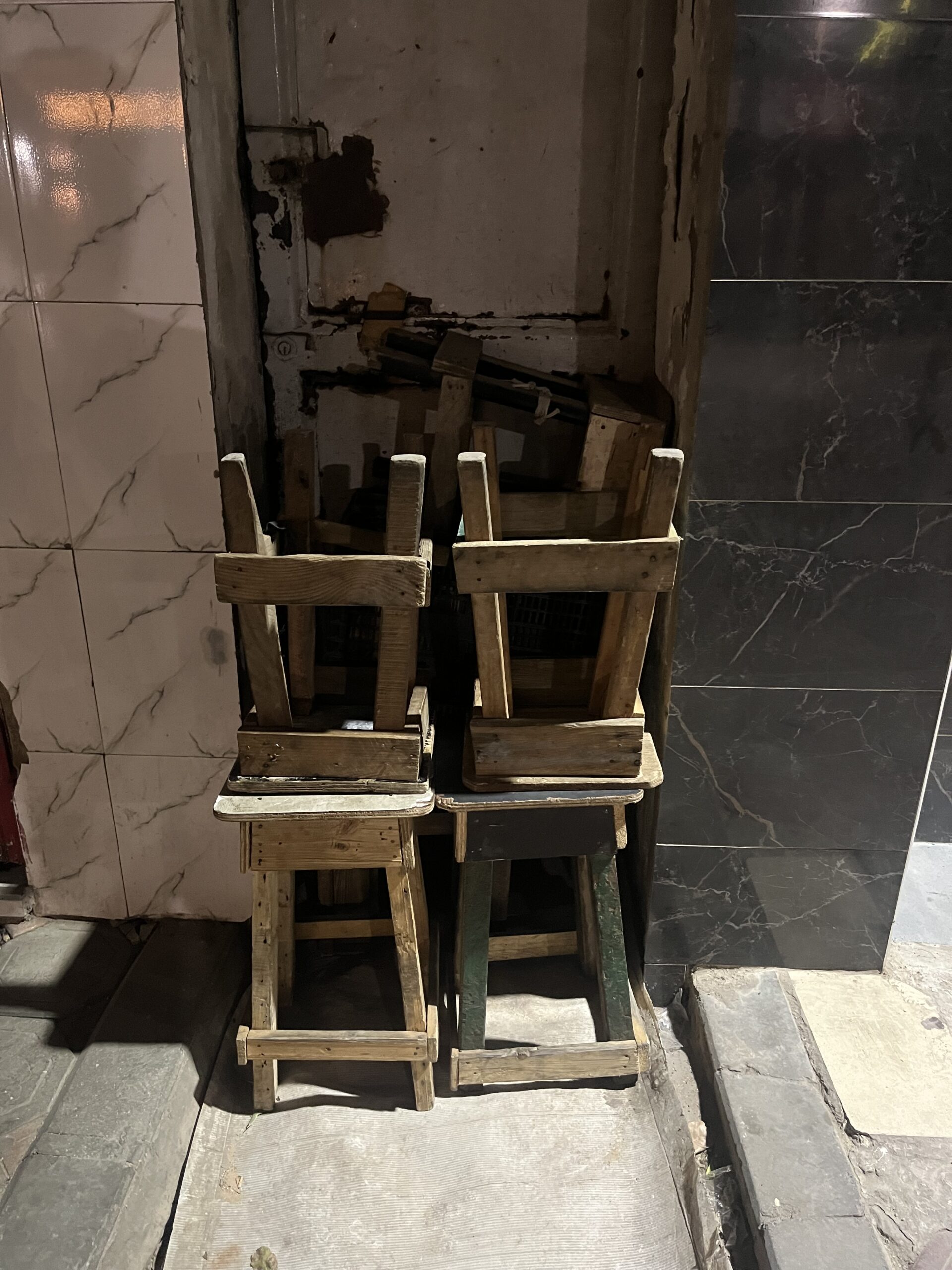
Today is an important day, because it is the last one in Dakar. We visit all the makers to see the results and even take them home. Before we arrive, we stop at the corner of a street near a large square. We get out and go through a gate into an inner courtyard. There is a kind of outdoor shopping mall. The courtyard is a mess with junk, bicycles and scooters, surrounded by small shops with mainly fabrics. One of the shops is the wholesaler where Rama buys her Bogolans and other cloths. The shop is not very big, but the walls are stacked with fabrics from the baseboard to the ceiling. In no time, the floor is littered with cloths that we have unfolded. I ask if that is not a problem, but Rama says that that is his profession. One cloth is even more beautiful than the other and we decide to buy a lot so that we can show a pile of African fabrics in the Netherlands and cover the African cushion bench. Rama discusses some things and I poke around a bit. Among the clutter I see a fantastic chair, or rather, a pile of chairs tied together with strings. Halfway up the stack, two footrests stick out at the front. It is the epitome of the repaired chairs I have seen in so many places. I ask what the chair is for and he tells me it is for security. They sit high up on the stack of chairs so that they have an overview. I clear the chair a bit and take some pictures.
Modou has adjusted and made extra chairs, especially to make sure that they are straight enough to stack. They are not completely straight, but enough to cover them. The wicker lamp is still not good and finished and the stripes in the weave on the chairs are still not in the middle. The beach chair is almost right. But for that chair we have to wait for the upholstery, of which I still have to deliver the design and the fabric still has to be woven. The aluminum cast objects are now finished as we requested, I can take these home with me!
Bibi received the quote for making the molds for rotational molding. I first asked Bibi if he thought the price was good, after all, he has experience with it. At first he did not understand my question, but the first thing he did was negotiate the price down. This is now fine and we give the go-ahead to get started.

Wednesday February 5th
Because the return flight is always a night flight, we still have the whole day. I have my last breakfast in the apartment and think that a board would be handy. But I don’t have time to buy one for Erik. I do get the idea that the woodworkers could make a solid wooden robot board! So I came up with a product for the collection at the last minute. On the way to Somone, where Rama lives, we stop by the chair weaver to pick out some colours for the tube armchair. In Somone we go to her boutique and look at all the products, especially fabrics, that she sells. Then we go to a beach bar of a friend for dinner in an incredibly beautiful place. It is a hut on the beach. On the bar is a trendy yellow electrical device. It turns out to be a battery of Chinese make that is powered by solar panels. The toilet is a bit more old-fashioned, you have to go to a somewhat higher plot between 4 walls to do your business in a hole with a pot on it. I don’t think everyone would like it as much, but I think it is one of the most beautiful toilets I have ever peed in. It is a kind of still life. When we leave, the owner (friend of Rama) is eating together with his family and entourage from a large bowl. Shared dining is not a new development here. They are so busy that it is not possible to capture attention. After the last lunch we say goodbye and Laye takes me to the airport. On the way we stop at the wood workshop where they have implemented the changes. They have also already made a table from the split trunk that I had chosen.
